If you have been around online poker for a while, the names of Ultimate Bet and Absolute Poker are surely ones you have heard, at least in passing. These two companies were involved in what remains the biggest, most shocking event in the world of online poker: the infamous Ultimate Bet scandal.
The two separate scandals happened during the first decade of the 21st century. Both poker sites ultimately went under, leaving millions of dollars in debt to their loyal players. In case you were too young to remember it or simply weren't around poker back then, let's take a trip down memory lane.
I have prepared a full breakdown of both the Absolute Poker and Ultimate Bet scandal, the sites' inevitable shutdown, and the massive aftermath they left behind. Sit back and take in this valuable lesson regarding the potential dangers of unregulated online gambling.
-
1
 Bonus £40 Freeor £600 bonus
 - Trigger the bonus: You need to deposit at least £10 and generate £10 in rake to trigger the FREE training bonus. | 18+ | BeGambleAware T&Cs Apply
-
2
Bonus $600or $100 tickets
-
18+ | BeGambleAware T&Cs Apply | Read full T&Cs
-
3
Ultimate Bet – How it started
Ultimate Bet emerged before the massive poker boom in the late 1990s. At that time, online poker was not yet a mainstream phenomenon.
Two individuals, Jon Karl and Greg Pierson, had started a small tech company under the name of ieLogic. The company’s early goal was to create software for MMOs (massively multiplayer online games), but that quickly changed. ieLogic created robust gaming software, and this technology became the core foundation for the first Ultimate Bet poker platform in the early 2000s.
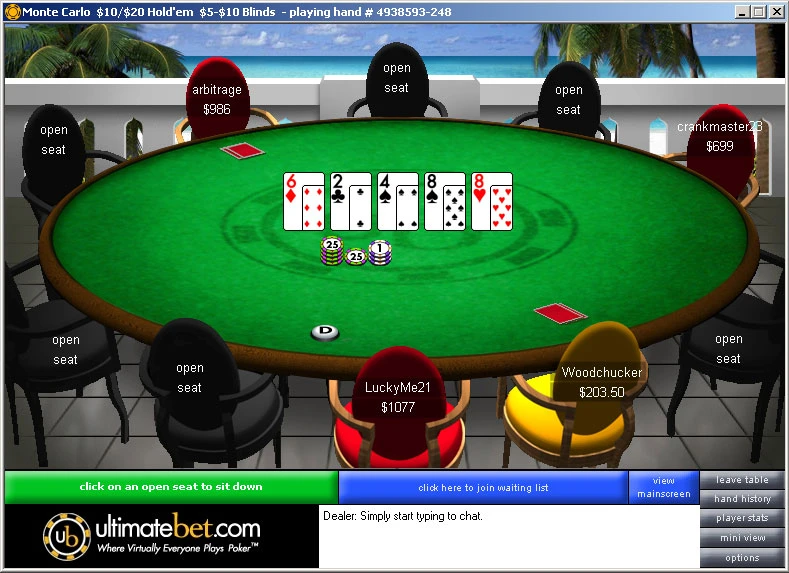
Russ Hamilton, a somewhat well-known poker pro, talked Pierson into launching this platform. They wanted to cater to a limited circle of wealthy poker players from Las Vegas and abroad. The site officially launched in 2001. Canada's Kahnawake Gaming Commission (KGC) issued a license for its operation. Naturally, this Commission had no real legal standing inside the USA.
Nevertheless, the site started running, and players flocked to the tables. With famous names like Annie Duke and Phil Hellmuth promoting it, numerous poker pros quickly started playing on the platform. Ultimate Bet started sponsoring live Texas Hold’em events. Big-name pros like Freddy Deeb and Eric Lindgren won titles in some of the early sponsored tournaments.
The breaking point for Ultimate Bet arrived in 2006 when the US government enacted the UIGEA (Unlawful Internet Gambling Enforcement Act). At this point, Ultimate Bet's parent company was publicly traded on the London Stock Exchange, which created massive legal problems. Things started to spiral. The founders eventually sold the company to Tokwiro Enterprises ENRG, owned by Joe Norton, the Grand Chief of the Kahnawake tribe. This move effectively placed Ultimate Bet, and soon Absolute Poker, under the ownership of the tribe.
Absolute Poker – The Beginnings and the Scandal
Like Ultimate Bet, Absolute Poker was started in the early 2000s. In 2003, a group of ambitious students from the University of Montana created this online poker site.
The business idea seemed great. They moved their company to Costa Rica to operate safely outside the legal boundaries of the USA. Absolute Poker, like Ultimate Bet, received its licensing from the KGC. For the first few years, Absolute Poker remained a relatively small platform. But when the UIGEA hit in 2006 and many major competitors fled the US market, Absolute Poker stuck around.
This meant that AP would become one of the biggest poker sites in America overnight. However, just a year into it, the site was hit by what’s now known as the Absolute Poker scandal.
In late 2007, the poker forums exploded with rumors of potential foul play at the site. These were not your common rants about bad beats. Players brought forward actual, data-founded accusations against particular accounts. One name, in particular, stood out. A player under the nickname “Potripper” was showcasing win rates that defied math, logic, and common sense.
A player going by the alias “CrazyMarco” requested his personal hand histories for a specific tournament. By sheer accident, the Absolute Poker support team sent him the entire master hand history file, which completely proved his allegations. The file revealed that Potripper played in mathematically impossible ways. Furthermore, Potripper was based in Costa Rica, and a specific “spectator” account watched every single one of his tables.
The implications were devastatingly clear. A “superuser” account was feeding Potripper real-time information about his opponents’ hole cards. The site initially rejected all accusations. Later, they quietly admitted that foul play occurred, although they never openly took full responsibility for the security breach.
The Ultimate Bet Scandal Exposed
Only a few months after the events at Absolute Poker, a terrifyingly similar event shook Ultimate Bet. It is worth noting that at this point, both sites had become a part of the Cereus poker network, owned by the Kahnawake tribe Grand Chief.
This time, investigators targeted a player using the nickname “NioNio”. His tournament and cash game results perfectly replicated the impossible win rates that Potripper achieved at Absolute Poker just months prior.
Similar to Absolute Poker, Ultimate Bet eventually admitted that some foul play was happening, and a number of accounts and players were implicated.
When investigators dug deeper into the Ultimate Bet scandal, they discovered a massive cheating ring. The ring relied heavily on information obtained by a user named “Auditmonster2”. This specific account possessed God-mode abilities, allowing the user to see every player's hole cards across all active tables.
In May 2008 Ultimate Bet released a highly controversial statement. They officially confirmed that cheating had occurred continuously for over a year. Consequently, the KGC fined the company $1.5 million. Despite the company admitting to the Ultimate Bet scandal, thousands of players permanently lost their trust in the Cereus poker network. Furthermore, the personal brands of sponsored pros Phil Hellmuth and Annie Duke suffered irreparable public damage.
Black Friday – The Great Shakedown
April 15, 2011, will go down in history as the worst day ever for online poker. On that day, the American Department of Justice (DOJ) decided to forcibly shut down several of the biggest poker sites still operating within the USA.
This massive sting operation included PokerStars, Full Tilt Poker, and Absolute Poker. The DOJ violently seized domain names and property associated with the sites. Authorities launched this operation to strictly enforce the Wire Act, the UIGEA, and other federal laws pertaining to illegal gambling and money laundering.
PokerStars and Full Tilt immediately shut down their US operations and did not try to reopen. Absolute Poker, however, arrogantly reopened under a different domain name and kept serving US players well into 2012.
When the authorities finally crushed the company for good, the site owed its players over $50 million. This massive debt existed despite the company clearly making millions of dollars in rake over the years. While a few mid-level executives at Absolute Poker received $300,000 fines, and the head of payment processing (Brent Beckley) received a 14-month prison sentence, the overall legal fallout remained shockingly minimal.
Hamilton and Pierson in on the Cheating?
Originally, the media portrayed the Absolute Poker and Ultimate Bet scandal as a story of rogue employees or hackers who gained illegal access to superuser accounts. However, was this really the truth?
Since the early days of the investigation, players heavily suspected that high-ranking company executives actively abused the superuser accounts. These suspicions grew because the winning superuser accounts were physically located in Costa Rica, near the company headquarters.
In 2013, Travis Makar, who used to work for Russ Hamilton for years, released a number of files and materials that painted a clearer picture of what went down.
Among these files was a secret three-hour audio recording between Hamilton, Pierson, and a couple of company lawyers. This conversation contained incredibly incriminating remarks. On the tape, Hamilton openly admitted that he personally stole roughly $18 million from the scam. The leaked materials explicitly showed how Hamilton bypassed the site's security, gained access to God-mode superuser accounts, and used them to rob players blind.

Things Made Right In Part
The scammers targeted thousands of players, but victims of the Absolute Poker and Ultimate Bet scandal were never fully compensated for their massive losses.
To this date, these events remain the biggest, most damaging scandals in the history of online gambling. The community knows exactly who is responsible. Yet, Russ Hamilton and his wealthy co-conspirators never faced criminal prosecution or jail time.
The funds that Absolute Poker owed its players after Black Friday were partially recovered, as the DOJ repaid some $33.5 Million to over 7,000 players affected by the shutdown.
A third-party facilitator named Garden City Group handled the distribution of these funds. Further rounds of payments may yet come, although that seems less likely with every passing day.
Millions more were lost forever. Many players simply decided not to file compensation claims. They feared potential federal prosecution for tax evasion or money laundering simply for being associated with the defunct companies. These scandals permanently smeared the names of Absolute Poker and Ultimate Bet.
FAQ: The Ultimate Bet Scandal