

Master poker strategy with PeakGTO. Try this poker solver for free.
Having covered the GTO strategy for defending against a continuation bet in position on different types of dry boars, today’s article will focus on wet flop textures.
Not surprisingly, navigating draw-heavy boards is somewhat trickier. Despite having the advantage of position, we have to be careful when creating our game plan on these types of flops.
Like the previous article, this lesson will cover one of the most common situations, where we are on the button and flat a preflop raise from the cutoff. Our defense strategy on the flop covers primarily 40 big blind scenarios, also touching on 25 and 60 big blind effective situations.
As always, before we proceed to specific examples and solver explanations, here’s a quick breakdown of the main takeaways from this lesson:
- We are defending 60% to 85% on wet ace-high boards depending on the c-bet sizing
- C-bets on ace-high wet flops are infrequent, and we can seize initiative when the opponent checks
- On wet high-card flops, we are defaulting to calling as our main defense strategy
- Against a small c-bet, we can raise a fair amount on wet high-card boards
- On dynamic low-card boards, continue over 85% against a small c-bet
Tip #1: Defend Between 85% and 60% vs. Infrequent C-Bet
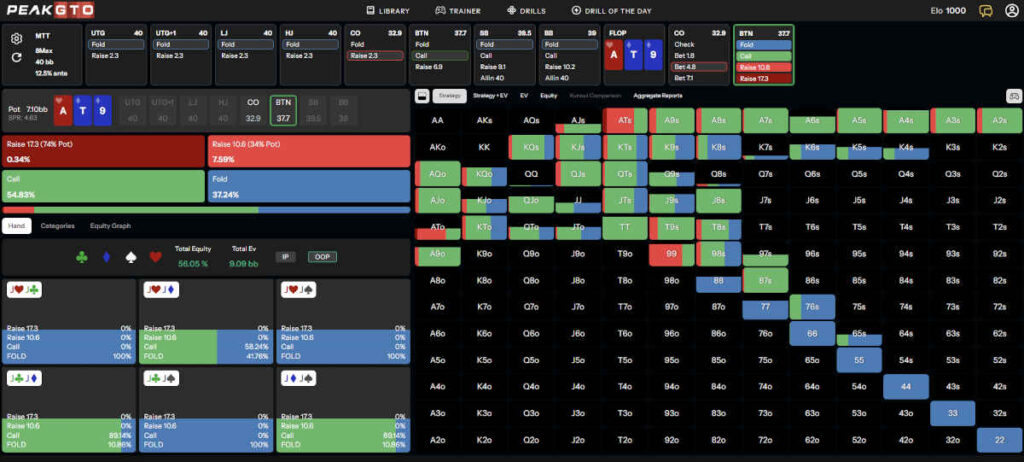
When it comes to wet flops featuring an ace, such as A♥10♦9♦, the out of position player has to be very cautious with continuation betting. The button caller can hit this flop in a variety of ways, which leads to the c-bet percentage of just around 14%.
The tiny c-bet percentage means that you won’t have to defend too often against a c-bet in these spots when playing 40 big blinds effective. When the out of position player decides to fire a continuation bet, you can expect them to use small (25% pot) and big (67% pot) sizing at a very similar frequency. In these spots, our strategy is summarized as follows:
- Against small sizing, we are continuing 85%, calling just over three-quarters of the time, and raising the rest
- Facing a larger bet, we can defend about 62%, primarily flat calling, with a very tiny raise percentage
The crux of it is that you won’t have to deal with these spots too much, as the button player will be happy to check to you in most instances.
When they do, you can seize the initiative, and you should be betting with about 40% of your range, using mostly the larger, 67% pot sizing. The betting range in this spot consists primarily of your strongest poker hands (best top pairs and better) and some of your weakest holdings, such as small pocket pairs under the board.
At 60 big blinds effective, things start to change somewhat. The cutoff player will c-bet around 25% of the time, using primarily small, quarter-pot size. Against that sizing, we are defending at just over 80%, calling about 75% and raising 25% of the time.
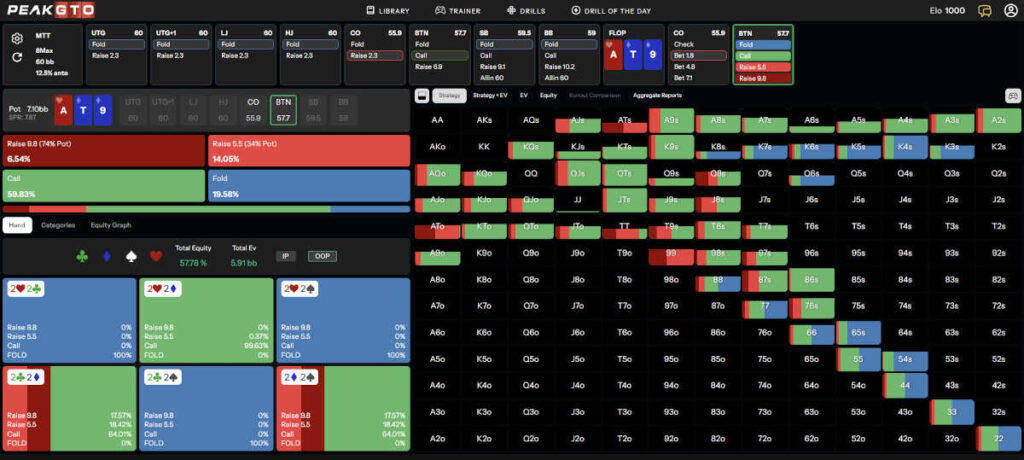
We can summarize our defense strategy vs. a c-bet in these 60 big blind spots as follows:
- Fold only the worst hands that have absolutely no coordination with the flop
- Primarily calling with hands that have solid showdown value like A8 – A2, K9, Q9, J9, T8
- Mostly calling with gutshot straight draws like KJ and 86
- Raising with our strongest hands like sets and two pair, combining it with open-enders and a couple of gutshot draws at a small frequency
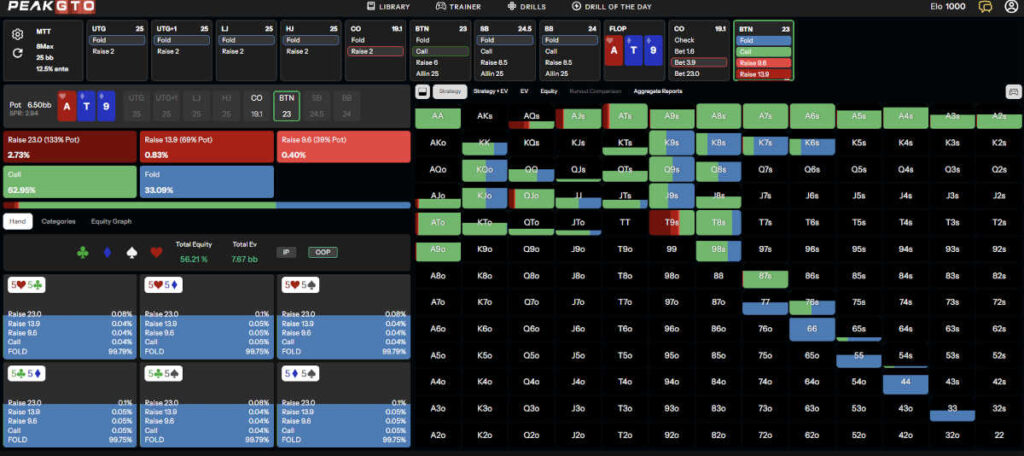
Finally, at 25 big blinds effective, you will face a continuation bet around 35% of the time, and you can expect it to be on the larger side, i.e., 60% of the pot. Against that sizing, we can defend with around 67% of the range, almost always just calling except with a few hands like AQs, T9s, plus AJs, ATs, and QJs at small frequencies.
Tip #2 High Card: Calling In Position as the Best Defense Strategy
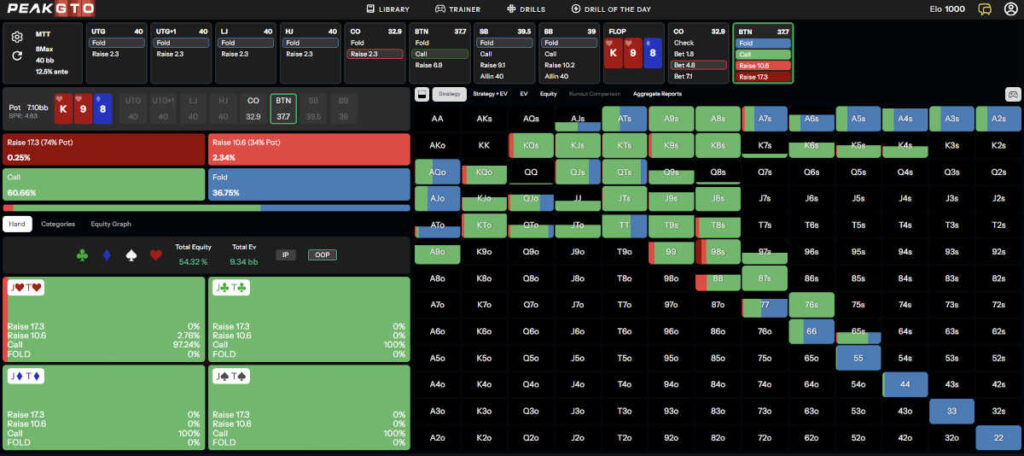
Dynamic high card flops, such as K♥9♥8♦, can be quite tricky to defend on when faced with a c-bet in position, which will happen around 35% of the time. In these spots, the cutoff will balance between two sizings: 25% the pot and 67% of the pot, with a preference for the smaller bet.
Against larger sizing, our defense strategy is straightforward, consisting mostly of calls with 64% of our range. We can find an occasional raise with sets and KQ, but even these are very low-frequency plays.
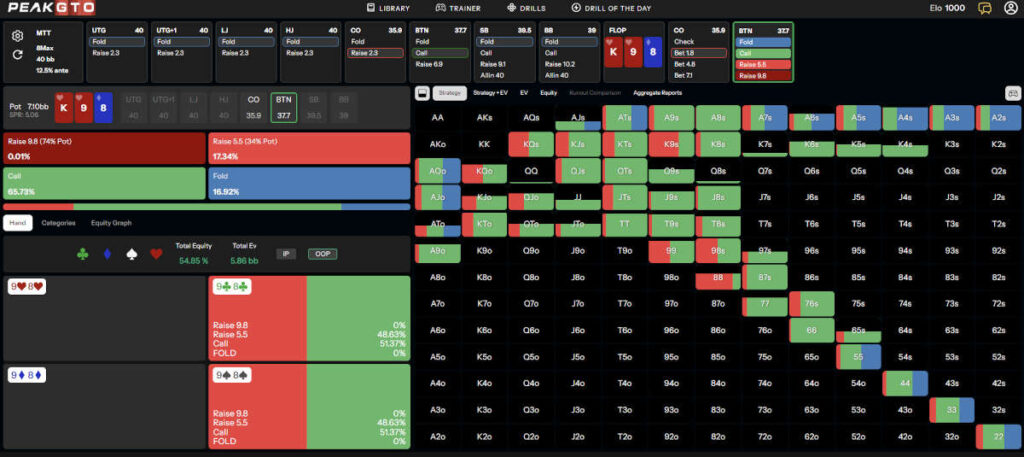
Facing the smaller, quarter-pot bet, our defense strategy becomes a bit more colorful and elaborate. In these situations, we can defend with 84% of our entire range, and our plan includes a fair percentage of raises with hands like sets, two pair, strong top pairs, and several straight draw combos:
At 60 big blinds deep, the OOP player will c-bet at around 40%, so their c-bet frequency is slightly increased. The sizing strategy is similar to the one used at 40 big blinds, which means our defense plan remains fairly unchanged as well.
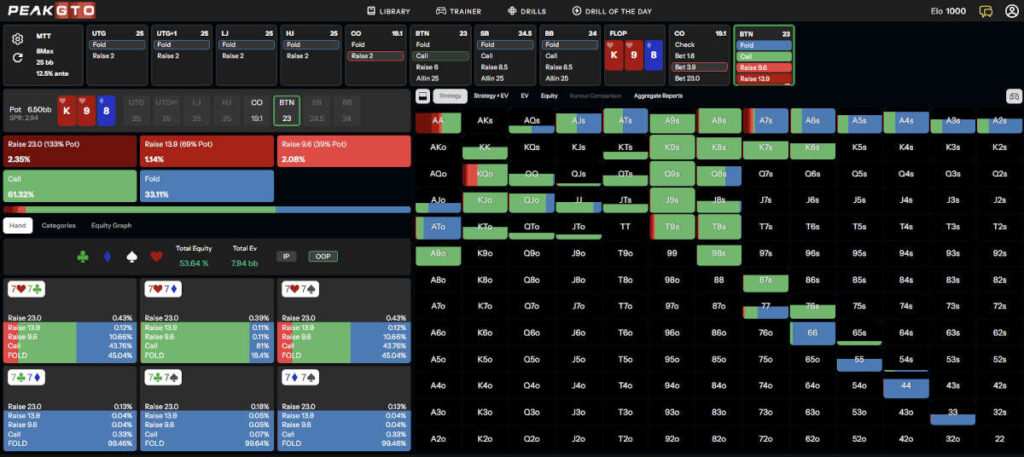
When effective stacks switch to 25 big blinds effective, the cutoff’s c-betting strategy changes somewhat. While the overall frequency drops to 25%, there is now a preference for using larger, 60% pot bets.
Facing this bet, we are still continuing with 67% of our hands, and, as is often the case in these short-stack scenarios, calling is the go-to option. Given small effective stacks, we are getting rid of hands like suited aces and the smallest pocket pairs, which had some playability in deeper situations.
Tip #3: Low Card Flops: Defend at a Very High Frequency (85%+)
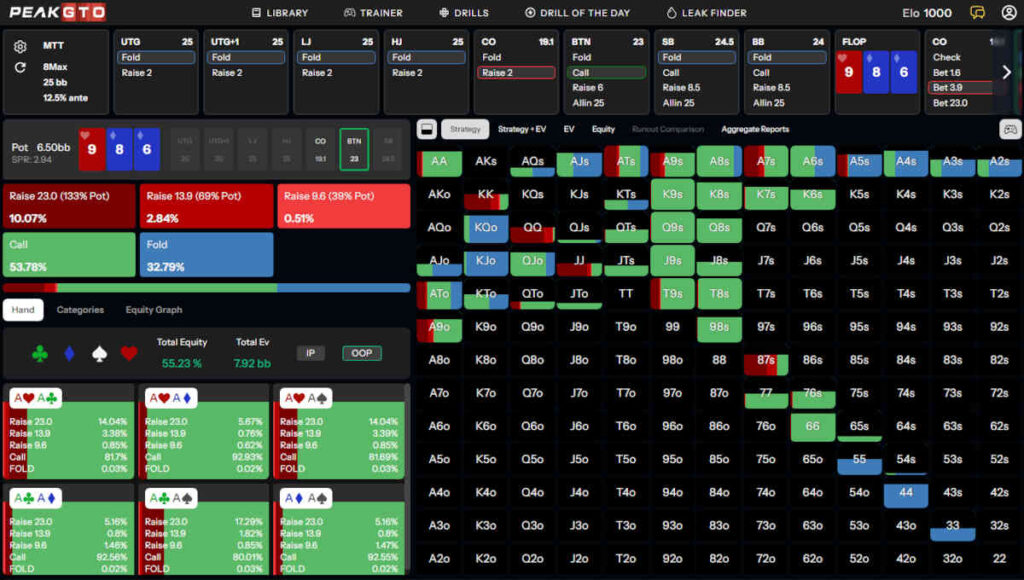
On wet low card flops, like 9♥8♦6♦, we can expect the cutoff to continuation bet just about half the time. In this case, however, they’ll be using a small sizing about two-thirds of the time and a big sizing the rest of the time.
Against the small sizing, we are defending at over 85% as our range contains more than enough strong hands on these textures to warrant it against a small c-bet. We are only folding the absolutely worst hands that have no playability and no showdown value.
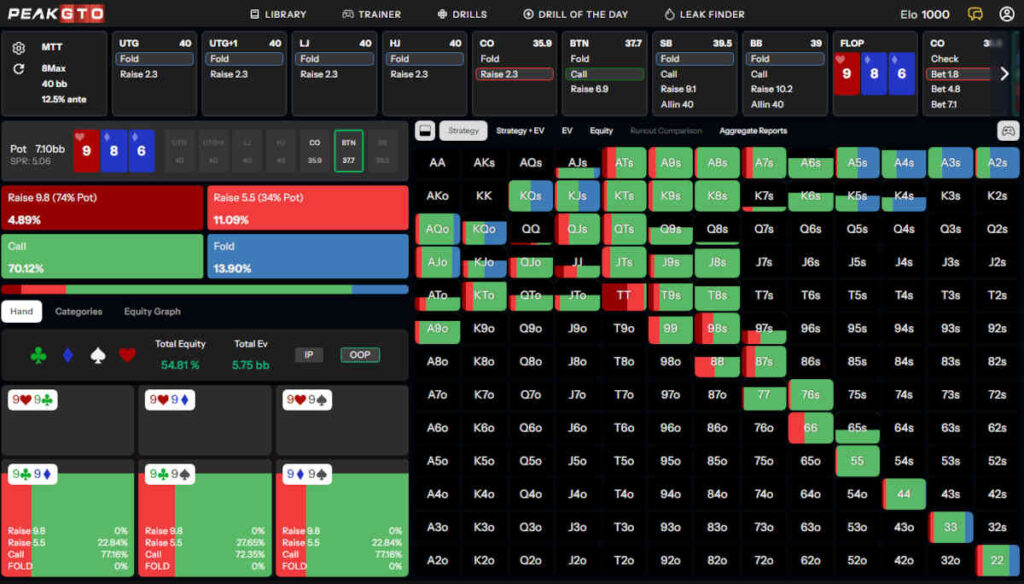
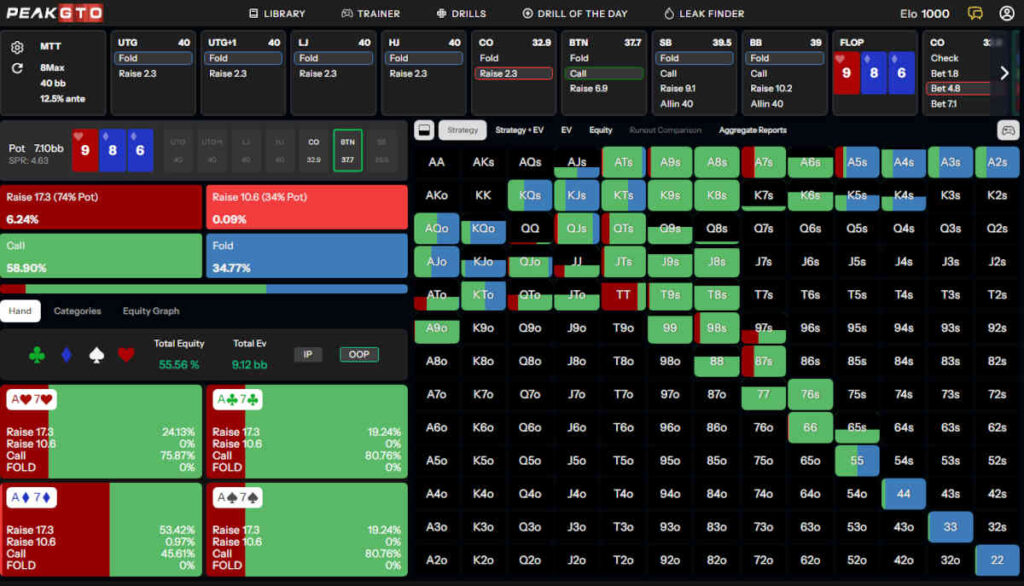
Against the larger, 67% pot sizing, we can defend at around 59%, but our strategy involves very few raises (except with hands like TT, JJ, 97s, and 87s). We are predominantly calling, but we are dropping certain weakest hands from our range, such as the smallest pocket pairs, and reducing the call frequency with overcards:
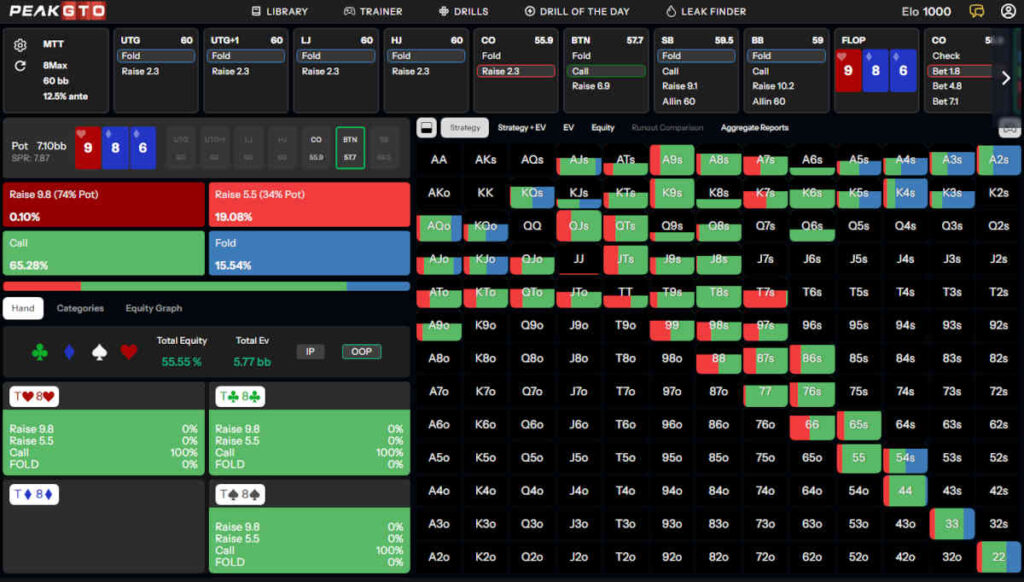
At 60 big blinds, the strategy changes fairly significantly. First of all, the cutoff position will only c-bet around 40% in these spots, and they will use the small, 25% pot sizing, almost exclusively. Against that sizing, we can continue with 85 of our entire range, raising almost quarter of the time:
Finally, at 25 big blinds effective, the cutoff will c-bet only around 25% of the time. They will default to a larger bet sizing when they do continue. Against that bet, we can defend around 68% of the time, and our defense strategy includes about 20% raises.
What’s really interesting about these spots is that, when we do raise, we’ll be using a super big, 133% pot sizing, putting a lot of pressure on the OOP player: