

When comparing 3 Card Poker vs Ultimate Texas Holdem, UTH offers the lower house edge under standard rules and optimal play. Three Card Poker is easier to learn and requires a smaller total bet at the same Ante. The figures below use the 5-4-1 Three Card Poker Ante Bonus and the standard UTH Blind paytable, with optional side bets excluded. But compare percentages on the same basis. House edge here means average loss divided by the initial Ante. The element of risk divides that same loss by the average total amount wagered, including later bets.
The calculations are explained in the Three Card Poker analysis and Ultimate Texas Hold’em analysis at Wizard of Odds. Comparing UTH’s 0.526% with Three Card Poker’s 3.37% mixes the two measures. Use 2.185% versus 3.37%, or 0.526% versus 2.01%.
3 Card Poker vs Ultimate Texas Holdem: how betting works?
In Three Card Poker, you look at all three of your cards and make one decision: fold, losing the Ante, or put out a Play bet equal to it. There are no extra cards to wait for and no later raise.
UTH starts with two equal bets, Ante and Blind. After seeing your two hole cards, you can check or make a Play bet of three or four times the Ante. If you check, the three-card flop gives you another chance: check again or bet twice the Ante. After two checks, the final two community cards leave a choice of a one-Ante Play bet or a fold.
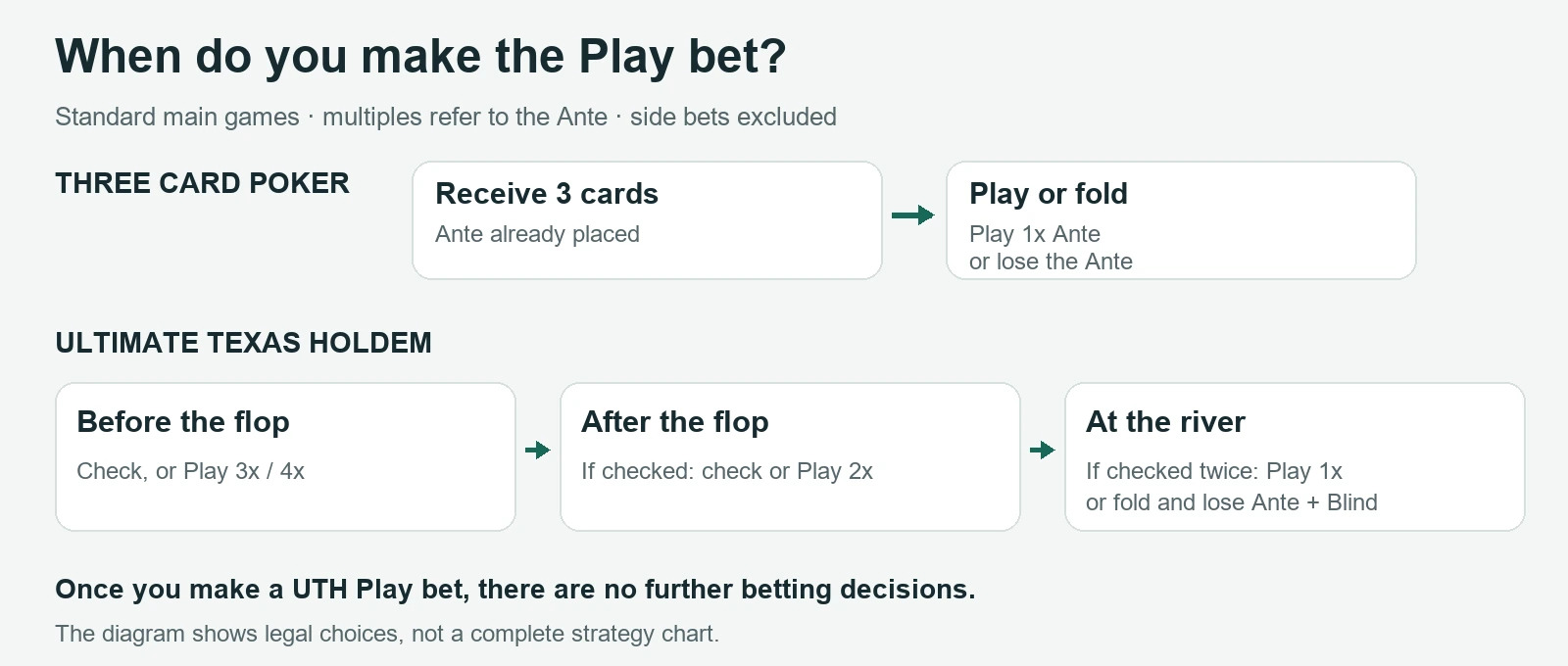
The timing matters. A 4x Play bet before the flop is not followed by a 2x bet and another 1x bet. Once you have bet, you wait for the result. If you fold at the end, both the Ante and Blind are lost.
Our Ultimate Texas Hold’em rules and strategy guide explains the betting stages in more detail. The published Nevada UTH rules provide a reference for the standard game.
A different kind of poker strategy
Neither game lets you make the dealer fold. In Three Card Poker, learning the main decision takes little time. UTH asks you to judge whether your cards justify a larger bet now or a smaller one after more cards appear. Knowing regular Hold’em hand rankings helps, but betting habits from a poker room do not transfer automatically.
What a 10 dollar Ante really costs
At Three Card Poker, a $10 Ante becomes $20 in action when you make the $10 Play bet. At UTH, the same Ante requires a $10 Blind before the deal. Add a $40 Play bet and you have $60 committed to one hand.
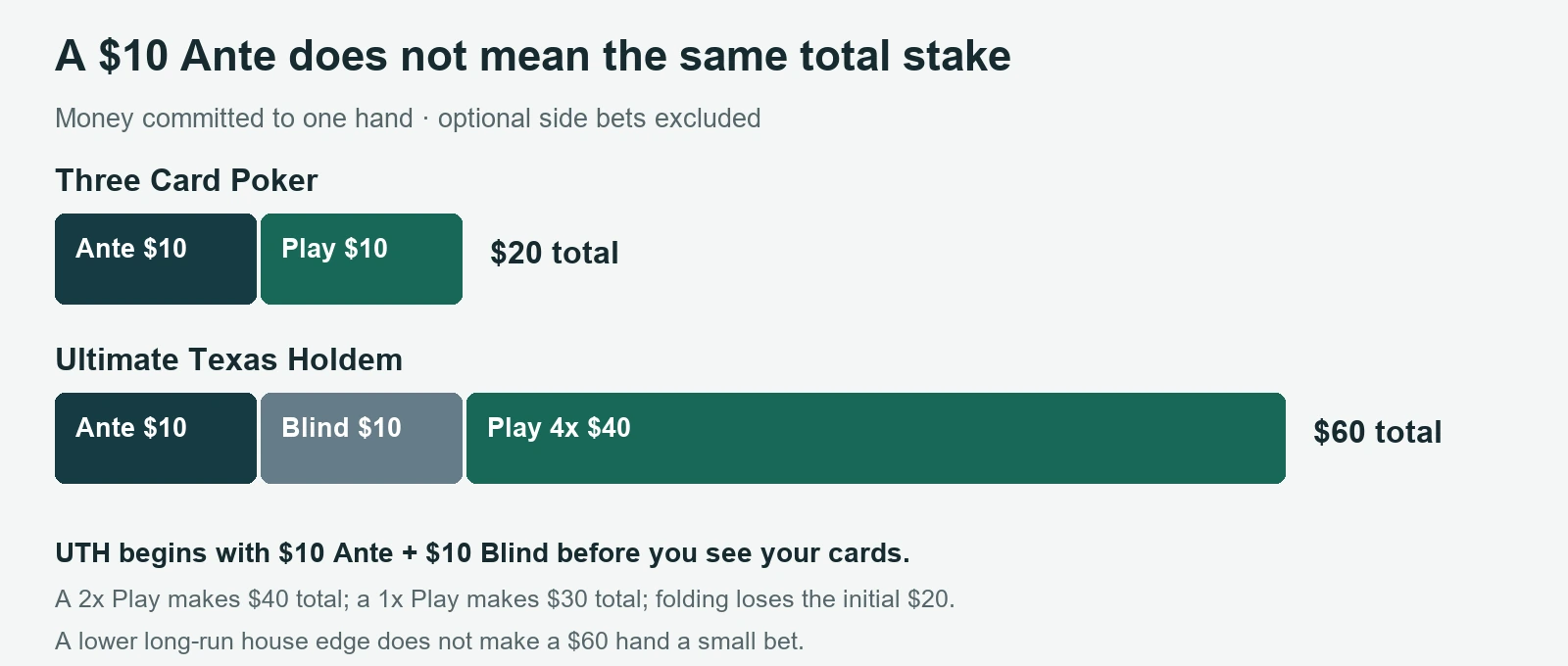
This is why the table minimum alone is a poor guide to what a game will cost. If a $60 loss on one UTH hand is too much for your budget, its lower percentage edge does not solve that problem. You need enough room for the full bet, including the early raise when the strategy calls for it.
Using the analyzed house edges, a fixed $10 Ante implies an average main-game loss of roughly $0.34 per round in Three Card Poker and $0.22 in UTH. These are calculated long-run averages, not the price of an individual hand. A short session can swing far above or below them, and faster play means more rounds of exposure.
For the denominator and assumptions behind the UTH figure, see our Ultimate Texas Hold’em house edge guide.
3 Card Poker vs Ultimate Texas Holdem strategy
For standard Three Card Poker, make the Play bet with Q-6-4 or better. For high-card hands, compare the highest card first, then the next: Q-7-2 clears the cutoff, while Q-6-3 does not. Any pair or stronger hand also clears it. The cutoff minimizes expected loss; it does not mean a borderline hand is likely to win.
Use our Three Card Poker rules and strategy guide for examples. For UTH, learn a complete strategy chart rather than simply waiting for the river on every hand. Our explanation of counting dealer outs in UTH covers one of the later decisions; a simplified rule is not the same as perfect play.
Dealer qualification changes the payouts
In Three Card Poker, a dealer below queen-high does not qualify: your Ante wins even money, and your Play bet pushes. If the dealer qualifies, the stronger hand wins both bets; equal hands push. The standard Ante Bonus pays on a straight or better regardless of the dealer’s hand.
UTH works differently. When the dealer does not make at least a pair, the Ante pushes, but the Play and Blind still have action. You can still lose those bets. When your hand wins, Play pays even money; the Blind pays on a straight or better and otherwise pushes. A losing hand loses the Blind.
For the three-card settlement and Ante Bonus schedule, see the Nevada 3 Card rules and paytables. These details are more useful than a table of hand frequencies labeled “winning odds.” Making a flush and finishing a round in profit are different events.
Hand rankings and side bets
A straight beats a flush in Three Card Poker. UTH uses standard five-card rankings, where a flush beats a straight. Do not carry the three-card order across to the other table.
Pair Plus in Three Card Poker and Trips in UTH are separate wagers on your hand. They are not required to play the main game. Ante Bonus is part of Three Card Poker’s main game, while UTH’s Blind is a required opening bet; neither should be confused with an optional side bet.
Read the whole payout schedule. For example, a Pair Plus table paying 40-30-6-4-1 has a house edge of about 2.32%; changing only the flush payout from 4 to 3 raises it to about 7.28%. A familiar bet name does not guarantee a familiar return.
3 Card Poker vs Ultimate Texas Holdem: which should you choose?
Choose Three Card Poker if you want one clear decision and a smaller maximum main-game commitment at the same Ante. Choose UTH if you enjoy working through a strategy and are comfortable with its larger early bets. Under the stated standard paytables, UTH has the mathematical advantage; that does not guarantee a cheaper or winning session.
Common questions – FAQ