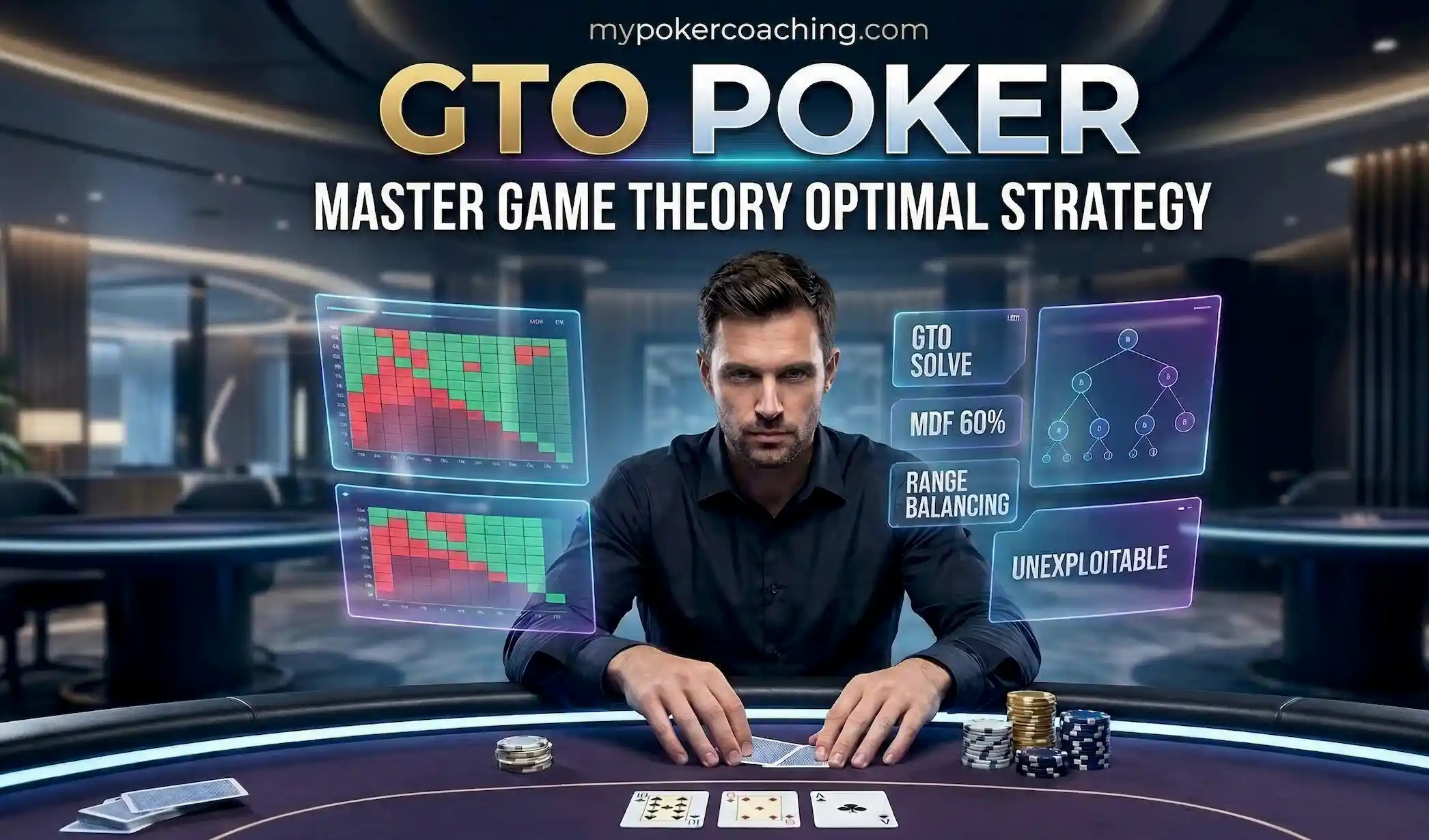
Are you looking to crush your poker games but simply can’t find anything that works well in every situation? Then GTO poker is the strategy you need to learn! The poker landscape has evolved drastically since the online poker boom in the early 2000s. Back then, raw aggression and basic intuition were enough to win, but today's games require a much deeper mathematical foundation.
Short for “game theory optimal”, GTO represents a mathematically perfect way to play poker. If you could play actual GTO poker, there would be no way for any opponent in the world to outplay you.
While no human will be able to replicate this exact GTO strategy because of its complexity, there are quite a few things derived from it that you can implement in your game to make yourself virtually unexploitable to your opponents.
In this guide to game theory optimal poker, we will introduce you to some basic GTO concepts and help you discover a whole new world of poker strategy.
What Is GTO Poker?
Game theory is a branch of mathematics that American mathematician John Nash invented in the 1950s. This branch of mathematics can be used to solve many different games, but poker players and enthusiasts have used it in recent years to “solve” Texas Hold'em Poker.
Applied to poker, the GTO strategy ensures a player cannot be exploited in any way. Unlike exploitative play, the game theory's optimal approach does not even look at the opponent across the table or care about their stats, tendencies, or anything else.
To put it in short, this approach tells you exactly what hands to play in each situation, how much to bet, and how often to fold by creating a perfectly balanced strategy.
In other words, playing perfect GTO poker would mean you always win or break even in the long run, regardless of who your opponents are.
Using GTO concepts such as range building and balancing, action frequencies, and mixing your strategy can make you into a very powerful force at the poker table.
Here is a great explanation from Jonathan Little, who created a guide for our readers.
GTO Poker Pros & Cons
Here are the main benefits of game theory optimal poker strategy:
- Works against anyone since you are guaranteed to at least break even or win
- Perfect strategy against very good players that also play balanced ranges
- Great against new players, you have no information about
- An optimal way to play in a situation where you are not sure how to proceed
It also has some drawbacks, so worth mentioning as well:
- It is very complex, so it is close to impossible to learn the GTO poker strategy for all situations
- It is not very effective in multi-way pots since there are too many variables
- Often, you will be leaving money on the table by not adopting more profitable exploitative plays
Overall, the Game Theory Optimal approach has more pros than cons, so you must understand at least the basics of it. Texas Hold’em is a complicated game, and the best approach is to use GTO as your starting point and adjust to exploitative play when you have information on your opponents.
Game Theory Optimal vs. Exploitative Poker
In modern poker theory, there are two major approaches. The GTO poker approach focuses solely on mathematics and balance, while the exploitative poker approach does exactly the opposite and focuses on player tendencies and patterns.
In simpler terms, a player playing a GTO poker strategy remains balanced at all times and always tries to take lines that his opponents cannot exploit. An exploitative player, on the other hand, looks to exploit his opponents’ tendencies even when it makes him exploitable.
The problem with playing exploitative poker is that it includes many assumptions and guesses, while the GTO strategy is based on fixed numbers and statistics.
By learning to play a semblance of GTO poker, your ranges will be balanced across the board, and every play you make will be unexploitable.
This makes GTO especially useful when playing against strong opponents whose tendencies are difficult to exploit and who are balanced themselves.
Taking the exploitative route can lead to higher profit margins when playing against weaker players, but playing unbalanced ranges can leave the player exposed.
There is a time and a place for both approaches. However, the GTO poker strategy is a baseline for any deviations and exploits you want to add to your game, which makes it the cornerstone of any strong player’s overall strategy.
Poker GTO Basics Explained
If you are used to an approach that focuses on exploiting your opponents, you will have to make some fundamental adjustments to switch over to GTO.
A GTO-focused player doesn’t make his plays based on what he believes his opponent might do, but rather constantly continues to build a balanced range of poker hands and use balanced bet sizes to ensure they can’t be exploited.
Before you can start playing any form of GTO poker, you will need to understand some basic GTO concepts, which we will introduce here.
Concept #1. Playing Balanced Ranges
The basis of the game theory optimal poker strategy is balance. You will see this word thrown around a lot when talking about GTO, and that’s for a good reason.
What balance means is that your range must never be weighed heavily towards value bets or bluffs in any situation.
Instead, your betting and raising range should always include a proportionate number of value bets and bluffs, which ensures your strategy cannot be exploited.
From your opponent’s perspective, it will be impossible to know if you are bluffing or betting for value if your range is not weighted towards either.
In such a scenario, the best your opponents will ever be able to do is break even against you, as no action they choose will tip the scales in their favor.
Concept #2. Action Frequencies
Action frequencies are the lifeblood of poker theory, and they often confuse players about this approach to the game.
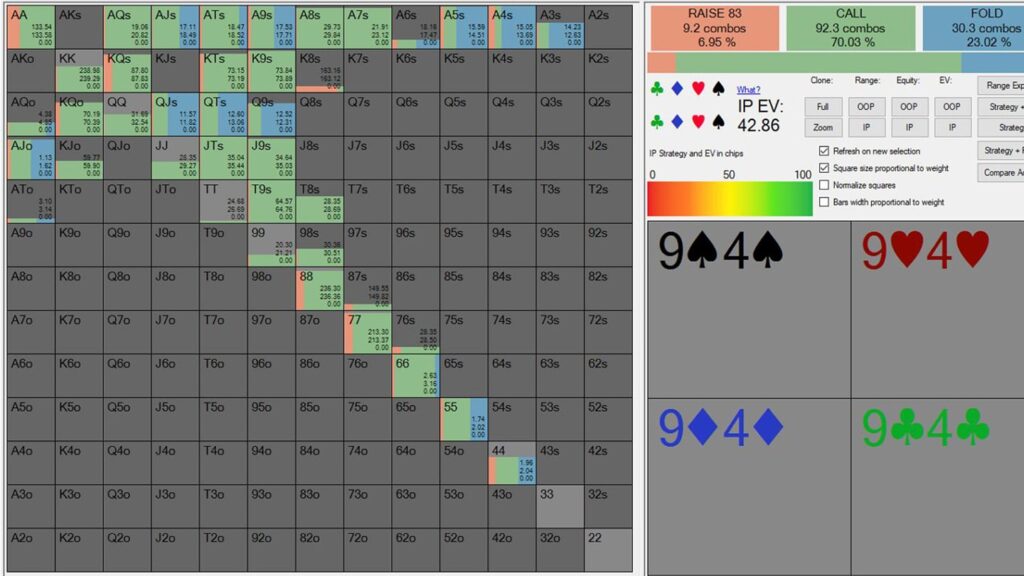
Looking at poker solver outputs, you will often see the software recommend checking a particular hand a percentage of the time and betting it the rest.
For example, the solver might recommend you use a hand as a bluff 20% of the time while checking it the remaining 80% of the time.
Using a mixed strategy, such as checking and betting with the same hand, makes your overall strategy even more difficult to exploit.
The problem with this approach is that it is nearly impossible for a living player to get the frequencies right, which is why most players simplify the strategy to some degree.
Concept #3. Minimum Defense Frequency (MDF)
Speaking of frequencies in poker, it is impossible to leave out the concept of minimum defense frequency (MDF), which is a method of making your calling ranges unexploitable.
The minimum defense calculation tells you what percentage of your overall range you must defend against your opponent’s bet to make it impossible for your opponent to exploit you by betting.
The MDF percentage changes depending on your opponent’s bet size. You can use this formula to calculate MDF on the spot: MDF = Pot Size / (Pot Size + Bet Size).
Once you know what percentage of hands you must continue with, you can pick the best hands to call or raise with from your range.
For example, you can choose to raise with your strongest value hands and some bluffs, while calling all your showdown value hands and some draws. At the same time, you will fold all your weakest hands that have no drawing potential.
The smaller your opponent’s bet, the higher percentage of your range you should continue with to keep your strategy unexploitable.
Here is a simple table with MDF percentages for the most common bet sizes, which you can memorize and keep in mind the next time you face a bet at the poker table:
| Bet Size | Minimum Defense Frequency (MDF) |
| Full Pot | 50% |
| ¾ Pot | 57% |
| 2/3 Pot | 60% |
| Half Pot | 67% |
| 1/3 Pot | 75% |
Following these simple numbers, you know that if you face a 1/3rd pot size bet, you need to defend 75% of your hands, so you will only fold 25% of the time and call or raise with the rest.
On the other hand, if you face a size bet, you only need to continue with 50% of your holdings, so knowing this basic poker math will help you make much better decisions at the table.
Concept #4. Preflop GTO Ranges
Preflop play is the one area where you can play GTO poker almost perfectly. Since there is a finite number of situations that can come up, you can apply GTO preflop hand ranges without making mistakes.
Poker solvers can create preflop hand ranges for opening, 3-betting, 4-betting, and every other preflop scenario that can come up.
In fact, you can download our free poker cheat sheet, which includes premade preflop hand charts that are solver-approved and perfectly aligned with the GTO poker approach.
By memorizing these preflop ranges, you will be able to hold your own in any poker game anywhere in the world and keep your opponents guessing about the actual cards you are holding.
To make the learning process easier, make sure to check our preflop poker charts and push fold charts.
Concept #5. Balancing Your Game Postflop
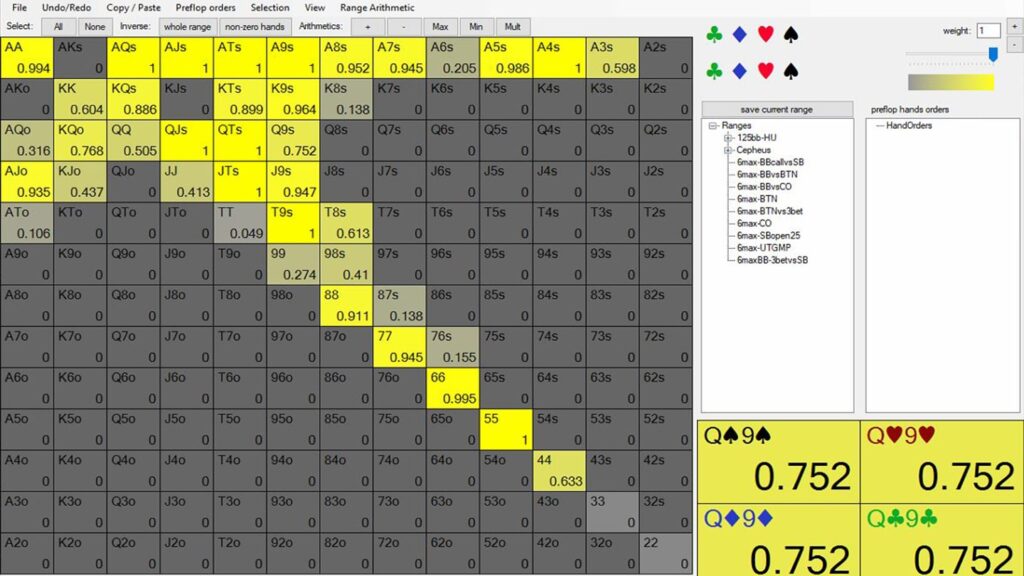
The power of poker solvers and the GTO poker strategy runs way deeper than preflop play, as solvers can create perfectly balanced ranges for every betting street. While the outputs you get can often seem a bit unorthodox and somewhat random, I can assure you they are not, and that every solver decision makes a lot of sense.
The solver chooses hands to bet, raise, call, and raise with based on various factors, including pot odds, implied odds, and even future bluffing potential.
With this in mind, you will often see the solver pick hands for bluffs that can improve to flush draws or straight draws on the turn, which is a logic that many human players have failed to use to their advantage for years.
When facing bets, the poker solver uses a concept known as “minimum defense frequency”, which is another poker GTO term you will need to understand, especially in heads-up poker.
Minimum defense frequency refers to the minimal percentage of hands in your range you need to defend against a certain bet size, which is a concept most players don’t normally consider.
The logic here is that when facing bets, you will always want to continue with the top portions of your range. The smaller the bet, the more of your range you have to continue.
By folding too many hands, you would be giving away value, while by calling too many hands against bigger bets, you would again be playing imbalanced.
In actual games, players often deviate from this GTO strategy and adapt to their opponents’ playing style, but playing according to the MDF will make you indifferent to your opponents regardless of their strategy.
Using Solvers for GTO Poker Solutions
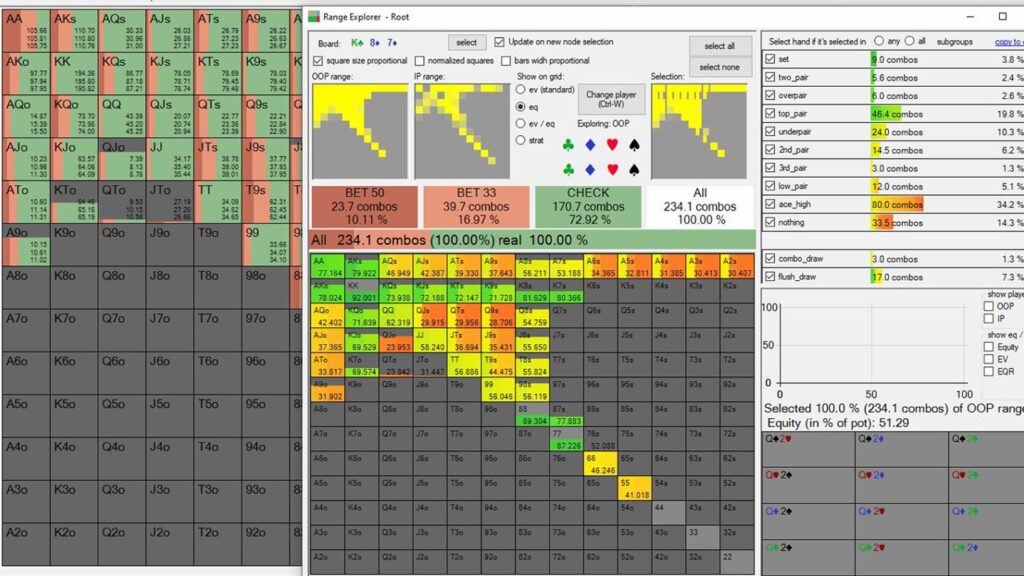
Game theory optimal strategy is too complex for a human brain to conceive on the go. Instead, it is learned with the help of computer programs called Poker Solvers.
Solvers are designed specifically to create perfectly balanced plays for different poker situations based on the inputs you enter.
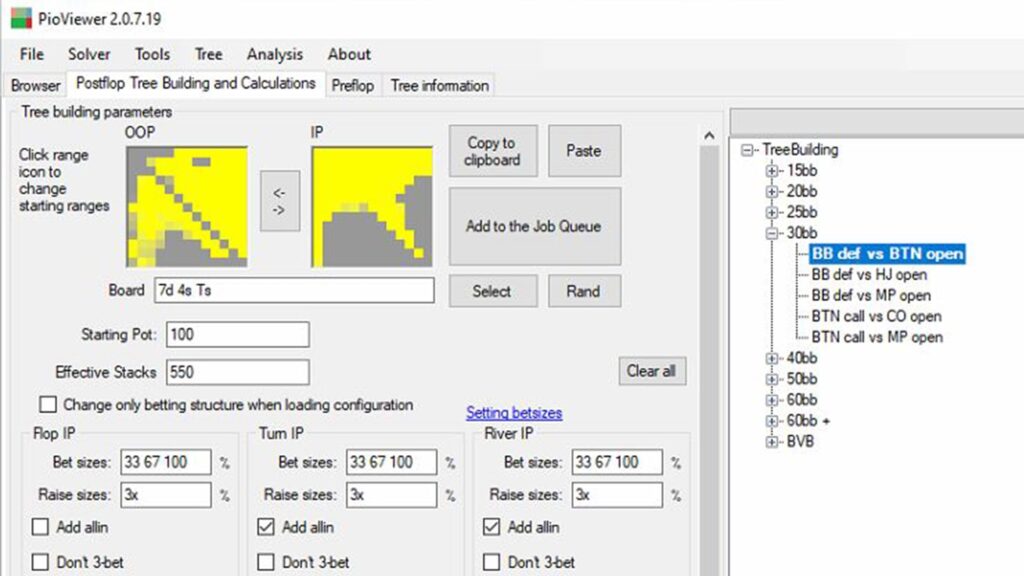
The only way for a solver to give you an output, known as a “solve”, is to provide it with the relevant inputs, which include player stacks, action on earlier betting streets, and betting options to choose from.
Based on the inputs you give it, the solver will assign each player with a potential hand range and tell you exactly how you should play the various hands in your range to remain balanced.
With every new input you provide, the solver will slightly modify its solution, changing the frequency of different actions you should perform with different hands.
Also, keep in mind that the solver will only choose from the bet and raise sizes you assign it in every given hand, as there is an infinite number of potential bet sizings in a No-Limit Texas Hold’em game.
Whether you are new to GTO poker strategies or have previous experience with them, the only way to effectively study them is to download a poker solver.
Let’s examine a few strong options and poker solvers used by the best poker players in the world.
GTO Wizard
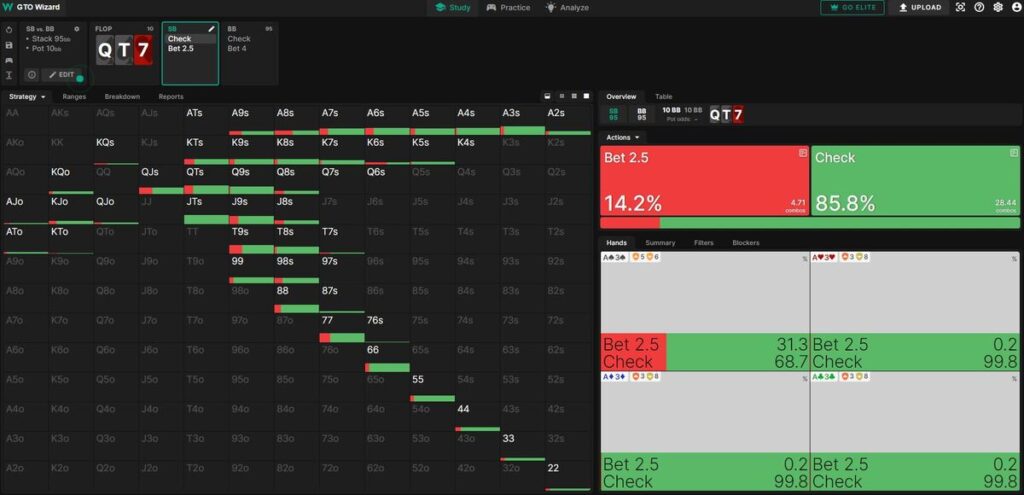
GTO Wizard is currently the most popular and accessible solver on the market, offering everything you can think of when learning the game. One of its biggest advantages is that it is completely cloud-based, meaning you don't need an expensive, high-end computer to run complex mathematical calculations – all the heavy lifting is done instantly in your browser.
It goes far beyond just providing raw solver outputs. With features like the GTO Trainer and interactive Drills, you can practice specific scenarios (such as defending the big blind or playing 3-bet pots) against a perfect virtual opponent. This allows you to spot your mistakes and fix your leaks in real-time, building a much deeper understanding of overall poker theory. It also includes range builders, customized study plans, and advanced studying tools for highly specific postflop situations.
If you are serious about mastering the basics of poker GTO strategy without getting bogged down by complicated technical setups, this is the ultimate all-in-one tool you must try.
Read the GTO Wizard review and try it for FREE.
Poker Snowie
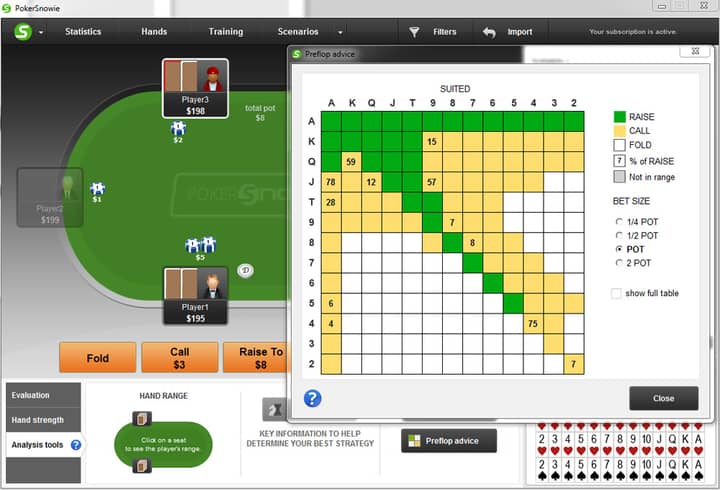
Poker Snowie is a great tool for beginners that offers simplified poker solutions, all still based on game theory optimal poker strategy.
For the most hardcore GTO poker fans, Poker Snowie might not be sufficiently advanced, but for most of us, this tool is exactly what we need to study GTO poker in a fast and efficient way.
Unlike other poker solvers that may take several minutes to produce a solution, Poker Snowie works very fast and produces results instantly, which is the biggest benefit of this software.
Read the Poker Snowie review and try it for FREE.
PioSolver
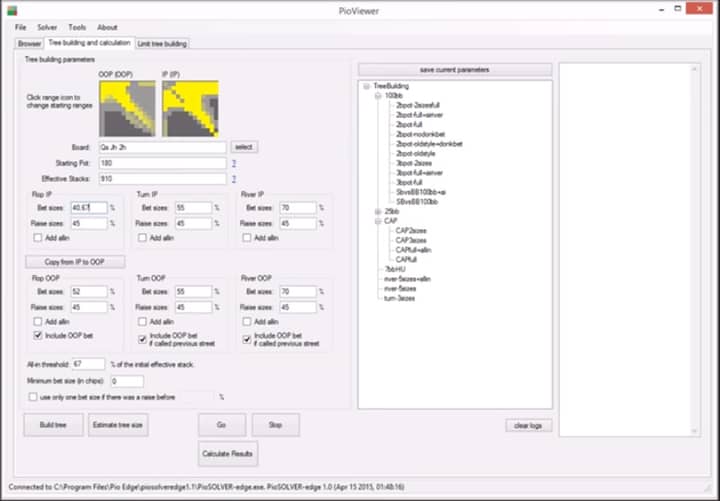
A legendary tool in the world of GTO Poker, PioSolver is one of the most advanced poker solvers out there, ideal for the more advanced users.
At the highest levels of the game, players typically use PioSolver to run their simulations and get their solves, including all the high-stakes crushers you see on TV.
If you want to someday join these elite ranks, you will have to adopt using PioSolver at some point, but we recommend easing into things with the simpler tools first.
How GTO Poker Solvers Think About the Game
Now that we have covered some of the basic concepts, let’s use GTO poker as an example to showcase how solver thinking differs from a typical poker mindset.
Let’s imagine you have reached the river in your low-stakes online poker game, and there is $20 in the pot. You are considering betting $20 into the pot, and you may be thinking about doing so mostly with your value hands or mostly with your bluffs, often depending on your opponent.
The way poker solvers think about the game is different, though. Since you are considering making a pot-sized bet, the GTO poker strategy recommends you have exactly one bluff for every two value bets in your range. Rather, you should be bluffing 33% of the time and value betting 66% of the time to be unexploitable with this bet size.
If you were to bluff more often, your opponent could counter by calling more. Conversely, value betting too frequently allows them to adjust by simply folding. However, by betting a full pot with exactly 33% bluffs and 66% value bets, you make their response completely irrelevant!
This example of GTO poker thinking is probably different from the way you normally think about playing at the poker table. Yet, it is the best way to make sure no player in the world can exploit you and your strategy works against everyone.
Master Poker Theory and Start Playing Like the Pros
If you want to take your poker game to the next level and be able to play against and beat anyone in the world, you will need to master the GTO poker strategy.
Getting the hang of GTO basics can take a long time, and you will never be able to replicate solver outputs 100%. Don’t worry, neither will anyone else!
Start studying the basic GTO poker concepts today, and download a poker solver to start running sims of your hands. To truly grasp the underlying math and logic behind these solver outputs, pairing your software practice with top-tier literature is highly recommended. Check out our guide on the best strategy and GTO poker books to build a rock-solid theoretical foundation. Take the first steps on your journey to becoming a “GTO poker bot” and crushing anyone who dares stand in your path.
FAQ