

Master poker strategy with PeakGTO. Try this poker solver for free.
In one of our earlier lessons, we covered the GTO strategy for big blind defense against the button c-bet on wet flops when playing 100 big blinds deep. However, this alone doesn’t fully cover this very complex and extensive topic.
In cash games, you’ll usually play with a stack of 100+ big blinds effective, but in tournaments, your stack will fluctuate, and it will usually be significantly under 100 bigs.
On average, you’ll spend a lot of time playing with 40 big blinds effective, which is exactly the stack depth we’ll focus on in this lesson covering tournament GTO strategy for big blind defense vs. button c-bet on wet boards.
Additionally, we’ll address a couple of other scenarios, namely 60 and 25 big blind scenarios.
Before we dig into specific examples and explanations, here are a few main takeaways to guide you through the article:
- On average, we are folding about half the time facing a c-bet on ace high wet boards
- With 25 big blind effective stacks, we can play our strongest hands on ace-high boards as pure calls
- We are defending 50% to 75% on wet high card boards, depending on the c-bet sizing
- On low card wet flops, we should be donk betting up to 25%
Tip #1: Fold 40% – 65% on Ace High Boards Facing a Button C-Bet
Ace high boards typically aren’t great for our big blind defense range. Playing 40 big blinds effective, we’ll pretty much never have very strong aces in our range after just calling the button raise before the flop instead of 3-betting.
Therefore, we’ll be folding 40% to 60% on wet ace-high textures facing a continuation bet, with the exact percentage depending on the c-bet sizing. Looking at the example of the A♥9♦8♦ flop, button will be using three different sizes on these boards:
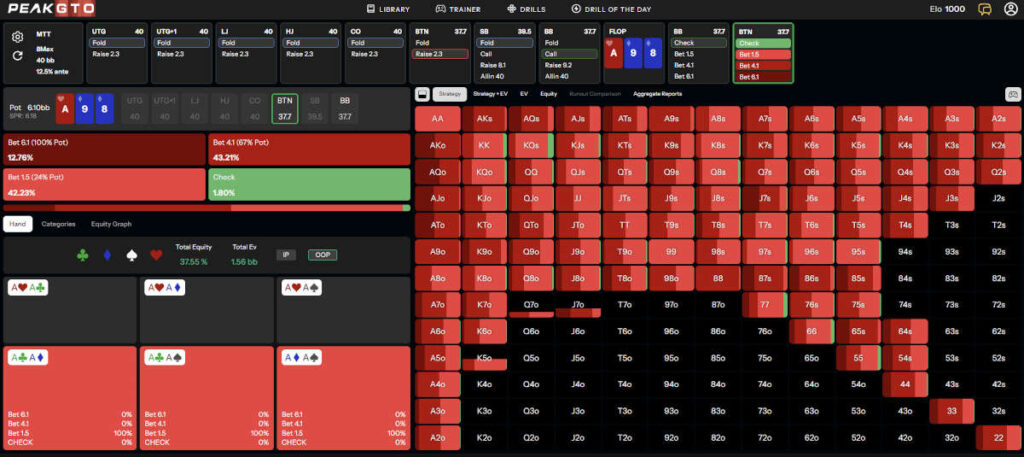
As we can see, the button uses the small (24%) and large (67%) sizing at nearly the same frequency. Not surprisingly, our continuing range facing a bet is the largest against the smaller of these two bets, totaling 60% of our entire range:
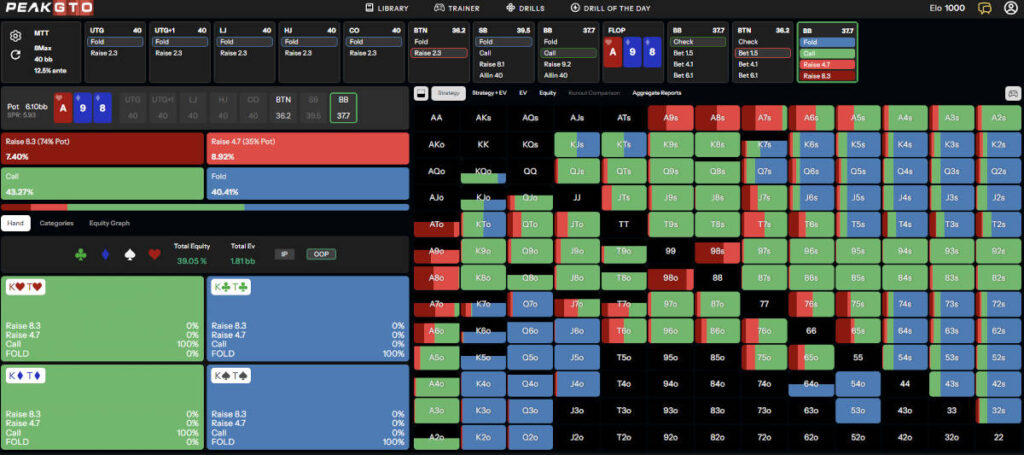
Not only that we are calling with around 43%, which pretty much encompasses all reasonable and even a few unreasonable hands that only have backdoor equity, but we also have over 16% of check-raises facing this small bet. These are mostly reserved for the strongest aces in our calling range before the flop, plus a few bluffs like gutshots and open-enders for balance.
Facing the larger, 67% sizing, our overall continuing range drops to just around 44%. Our weaker aces now fall completely into the call category, and we are folding some of our weakest calling hands from the earlier scenarios, including a few of the weak bottom pairs.
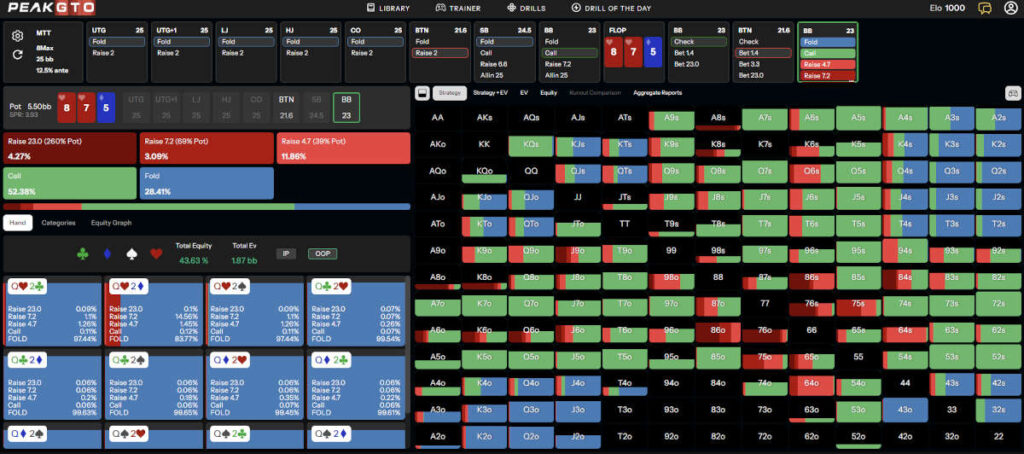
Finally, facing a large, 100% pot sizing, we are continuing with only around 36%, and calling is by far preferred option. We are now raising only with the strongest of our hands (two pair and AT), and a few select straight draws for balance:
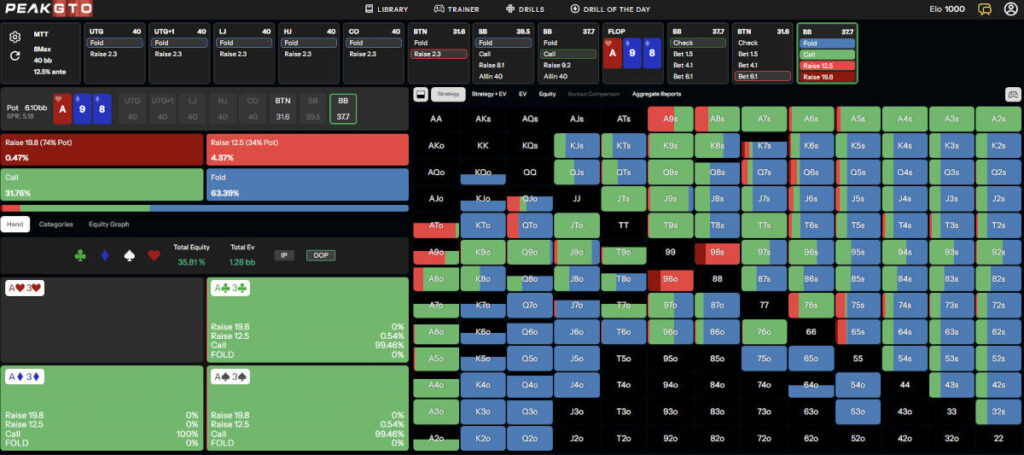
At 60 big blinds effective, the entire strategy remains virtually unchanged for the button and the big blind. There are a few small differences, but nothing needing an elaborate explanation.
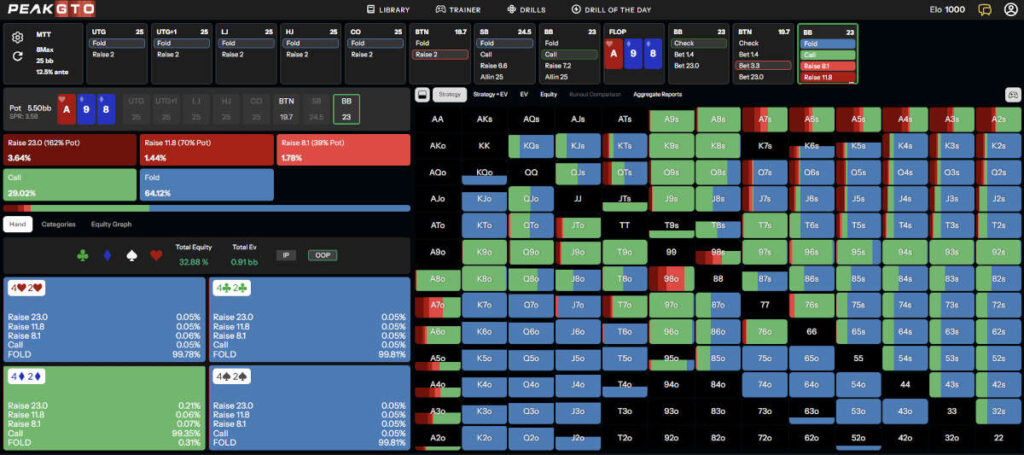
At 25 big blinds, though, there are significant strategic adjustments. With these effective stacks, the button player will utilize the 60% sizing almost always, forcing us to play pretty straightforwardly. We can defend about 36%, primarily calling with our decently strong hands, and throwing in a few raises with top pair and bottom two pair combos.
What’s interesting is that our strongest poker hands in this scenario, i.e. A8 and A9 become pure calls. Stacks are shallow enough where we don’t need to force the issue to get chips in the middle, and our hand is strong enough that it doesn’t require that much protection:
Tip #2: Defend 50% – 75% on Wet High-Card Flops
The big blind defense on wet high card boards isn’t as complex as that for ace-high flops, but there are still nuances to be aware of.
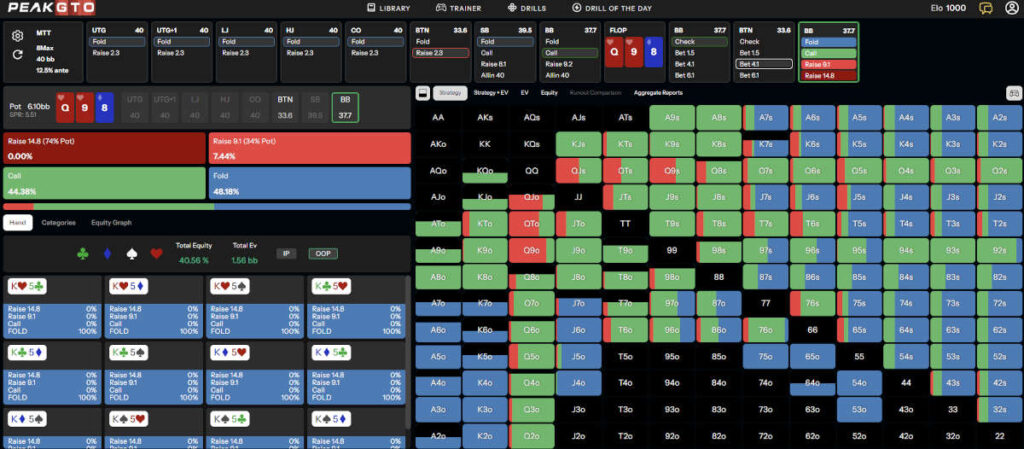
On these types of flops, the button player will primarily use two sizings when they do decide to c-bet: 67% and 24% of the pot, with the 67% option being a slight favorite. Let’s look at the board of Q♥9♥8♦:
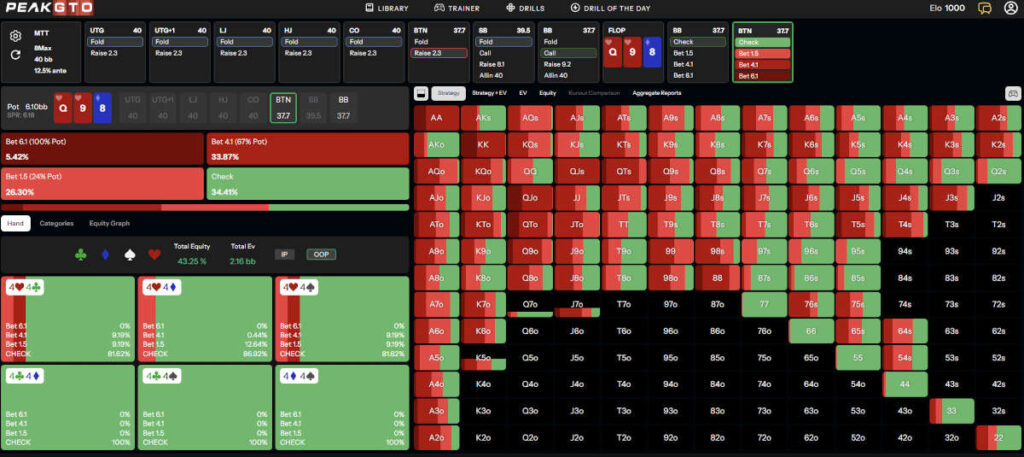
Facing that two-thirds bet, we should be defending right around 50% of our range in the big blind. The default action is calling, with about 7% raises with the best top pair hands and top two pair combos. Interestingly enough, 9-8 (bottom two pair) remains almost exclusively in our calling bucket:
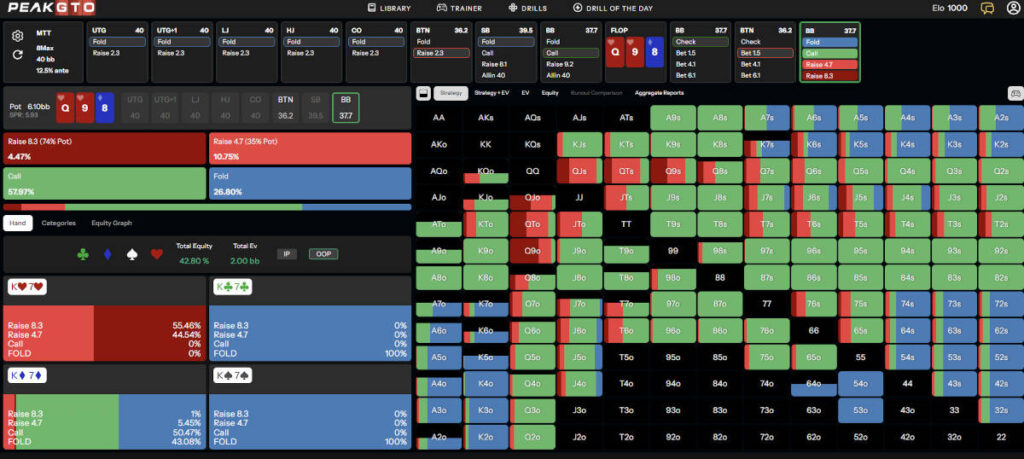
Against the somewhat less frequently used smaller sizing of a quarter pot, we can defend much more liberally, sticking around with almost 75% of our entire range.
The only hands that we are folding here are those with no showdown value and close to zero potential to improve, such as small suited connectors with no flush option, and hands containing just one overcard with no additional draws, such as K4o.
At 60 big blinds effective, just like in the previous example, the overall strategy doesn’t change that much. The main adjustment from the button side is that they will be using the large, 67% of the pot, sizing at an increased frequency.
With shallower stacks (25bb effective), the button will resort to smaller, one-quarter pot bets much more frequently, but their overall c-betting frequency increases to almost 85%.
Against the button’s small, 25% pot bet, we should be defending just under 70%, calling about 50% and raising with the rest, as shown below:
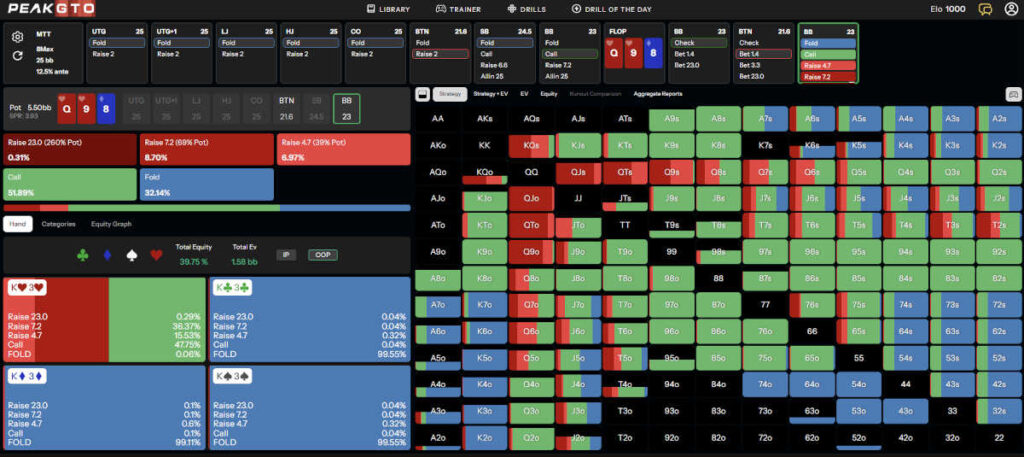
Facing a small bet, even with a relatively short stack, we need to defend with a rather wide range to ensure the correct minimum defense frequency (MDF).
Tip #3: Donk Bet up to 25% on Low Card Wet Flops
Low and connected flops are a rather interesting category in this framework as these are only boards where the big blind has a significant donk range. While this isn’t directly connected to the topic of defending against c-bets, knowing all defensive resources available to you will decrease how often you have to face a continuation bet in the first place.
According to solvers, on these types of boards, the big blind should be donking (betting into the original raiser) around 13% of the time, as we can see on the example of the 8♥7♥5♦ flop.
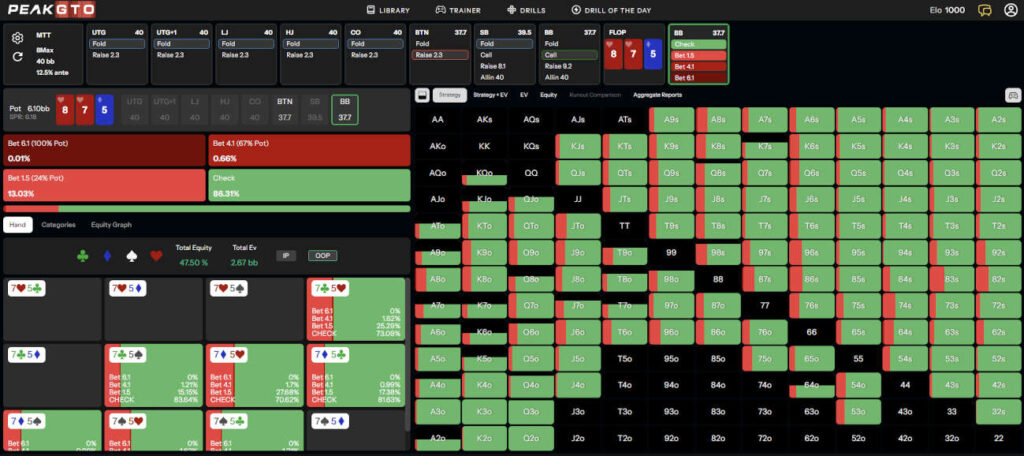
While this is still a relatively low frequency play, you can see that it is fairly evenly distributed across our defense range, so we can occasionally make this move with a variety of top and middle pair holdings as well as some two pair combos.
In more traditional lines, after we check, we can expect to face a continuation bet just about half of the time. The button will use 67% and 24% sizing, with the former being almost twice as frequent.
Facing a larger bet, we can defend with around 55% of our entire range. While the go to option here is to just call, we will be check-raising some of the time with top pair plus straight combos, made straights, and some naked straight draws for balance:
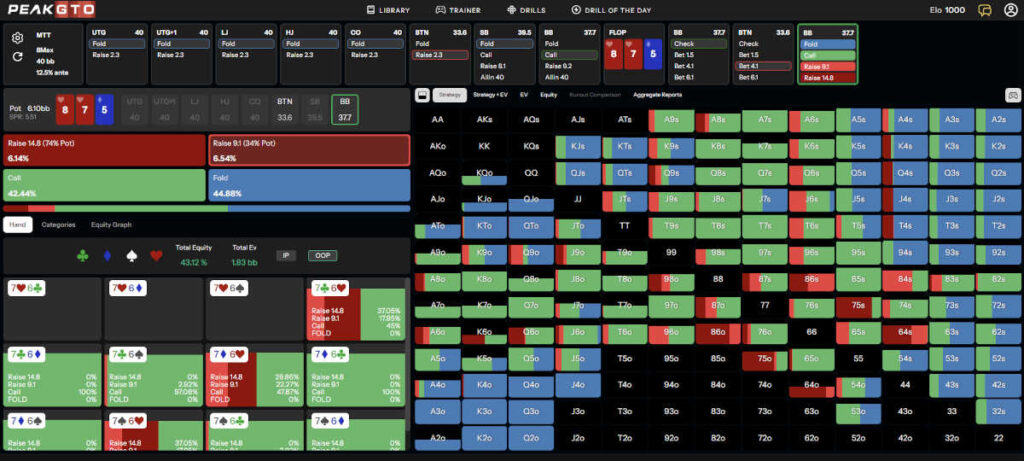
Not surprisingly, facing a smaller c-bet, we can defend much wider, continuing with three quarters of the entire range, and only getting rid of our weakest holdings.
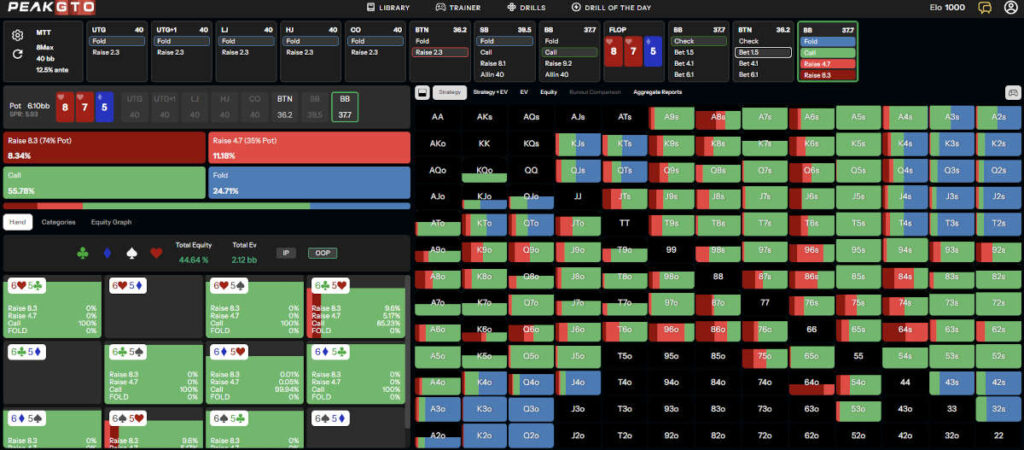
At 60 big blinds effective, the GTO strategy remains largely unchanged. We still have a donk range, which increases slightly with deeper stacks, going to 14%. After checking, the button player will c-bet right around half the time, using the same two sizing options, so if you master the 40 big blind strategy, you’ll be pretty much set for 60 bigs as well.
At 25 big blinds, however, there are some pretty significant changes. First of all, our donk range increases to almost 25%, and a small portion of the time, we will be using a huge, all-in sizing when betting into the original raiser:
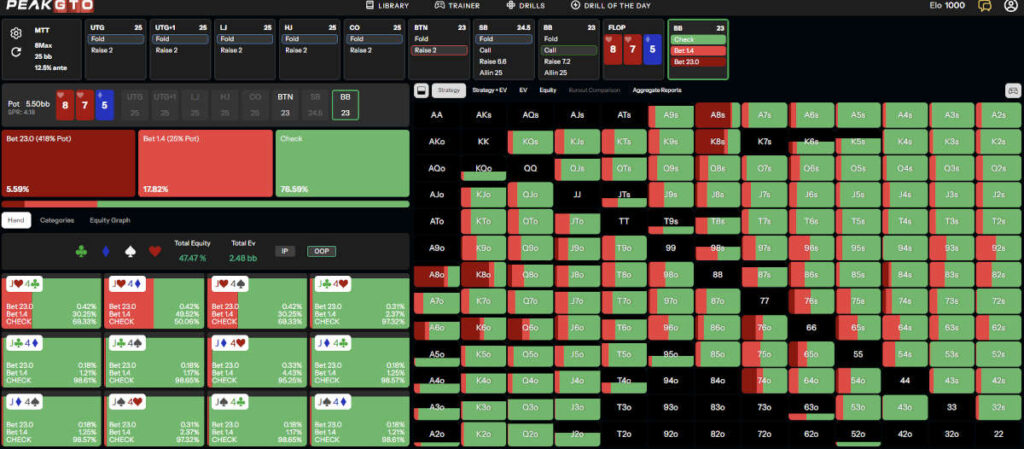
After checking, we’ll still face a c-bet from the button just around half the time. You can expect them to primarily use the small, 25% of the pot, sizing. Against this sizing, we are again defending at a frequency of over 70%, using the strategy similar to that at 40 big blinds.