

To succeed in poker, one must learn various mathematical strategies, master the use of different poker software solutions, and continually adapt to a rapidly changing environment. It is a long and hard path to success if you want to be at the top of this game. However, there is another side to poker that is often neglected, but equally important, if not even more so. Mastering the mental game and learning how to navigate extreme poker variance is absolutely essential for anyone looking to build a long and successful career in this industry.

This other side of the game involves much more than just learning your pre-flop ranges, betting frequencies, or GTO math. It requires supreme emotional control. Today, we will cover the mental framework you need to survive and thrive at the tables.
Understanding Your Motivation and Poker Variance Mindset
Figuring out what you want to do for a living is probably one of the toughest decisions you have to make in life. There are countless career paths available, and each one has certain advantages and drawbacks that come along with it. Poker is no different. Poker is no different.
Playing for a living can be incredibly rewarding in many of its aspects, but it certainly has its downsides. While the game provides a high degree of freedom, flexibility, and unique opportunities in life, it also requires a remarkably strong mental frame to deal with all the rough patches along the way. Excellent money management skills are non-negotiable.

Defining Your True Poker Goals
Before you decide to devote your time and hard-earned money to this game, there are a few critical questions you should honestly answer:
- Why do you want to play poker?
- What is your primary motivation? Is it the pursuit of money, or a deep passion for the game itself?
- Do you have enough time, energy, and dedication to take this game seriously?
- Why do you believe grinding at the tables is the right choice at this specific moment in your life?
- What do you ultimately want to reach by playing poker; what is your end goal?
For those still deciding how much time they want to devote to the game, all of these questions are very important. But, they are equally as important for those already playing poker full time.
For those still deciding how much time they want to devote to the game, these questions are vital. But they are equally important for those who are already playing poker full-time. Poker players have to deal with massive emotional swings. It is much easier to get through the darkest days of poker variance if you deeply understand the core reasons that motivated you to start playing in the first place.
Preparation: The Key to Handling Poker Variance
To an outsider, playing poker, whether online or live, can seem like an incredibly easy thing to do. You just sit down, look at a screen or hold some cards, and play for a few hours every day. How hard can it really be, especially once you get your basic strategy right? It’s just a simple card game, isn’t it?
However, any professional knows this couldn’t be further from the truth. Any single decision made during your session can have serious monetary implications. Playing a single hand wrong can wipe out the entire profit you’ve been accumulating over the past five hours of flawless grinding.
A bad play deep in a tournament can make the difference between a small, virtually irrelevant cash and a massive six or seven-figure payment.
While bad decisions can’t be avoided entirely, they can be significantly reduced by maintaining high concentration and the ability to focus every single time you play. Crucially, this preparation starts far away from the tables.
The Essential Pre-Session Routine
When you sit down to play completely unprepared, even simple, everyday occurrences can throw you off balance. If an opponent slow rolls you or throws an angle shooting play, you might start tilting immediately. Something that generally wouldn't affect your performance can hurt your win rate significantly when you are not mentally ready for the grind.
You need to get enough rest and have a clear mind. Here are a few essential habits that can help you:
- Getting enough sleep: If you’re playing tired, you will inevitably struggle to maintain your focus, and your ability to make complex mathematical decisions will be seriously hindered.
- Not playing hungry: Don’t start your session thinking you can just eat later. You should eat a healthy, balanced meal before you start so that you have enough energy to last for several hours. Keep healthy snacks and water nearby if you are settling in for a long session.
- Exercising before you play: Getting some physical activity just before your session will help improve your blood circulation and wake up your brain. A quick run or gym session works wonders for your mental clarity.
- Clearing your thoughts: Try to leave all personal problems, arguments, and outside obligations behind before you start playing so that you can fully immerse yourself in the session.
- Warming up your poker brain: Review some hand histories from your previous session, read a strategy article, or watch a video of high-level hand analysis to get into the “zone.”
Taking these steps to prepare yourself physically and mentally for every session will help you make optimal decisions, maintain deep concentration, and ultimately achieve vastly superior results. If not, check out reviews of poker training sites, and spend some time mastering the game.
-
1
 Bonus £40 Freeor £600 bonus
 - Trigger the bonus: You need to deposit at least £10 and generate £10 in rake to trigger the FREE training bonus. | 18+ | BeGambleAware T&Cs Apply
-
2
Bonus $600or $100 tickets
-
18+ | BeGambleAware T&Cs Apply | Read full T&Cs
-
3

Understanding and Dealing With Poker Variance
No matter how exceptionally good of a player you are, you simply won’t be winning all the time. Poker variance is an inescapable, mathematical part of the game, and absolutely all players go on massive upswings and devastating downswings.
You might be a winning player, and over a large sample of hands, you’ll realize your expected win rate. However, due to poker variance, you can go on a relatively long losing stretch, which can influence your mind frame.
While there are certain adjustments you can make to lower your risk or lessen its effects on your bankroll and mental state, there is absolutely no way to avoid variance completely. You might be a proven, winning player, and over a massive sample size of hands, you will eventually realize your expected win rate. However, due to the harsh reality of poker variance, you can easily go on a relatively long losing streak, which will heavily test your mental framework.
The Mathematical Reality of Poker Variance in Tournaments
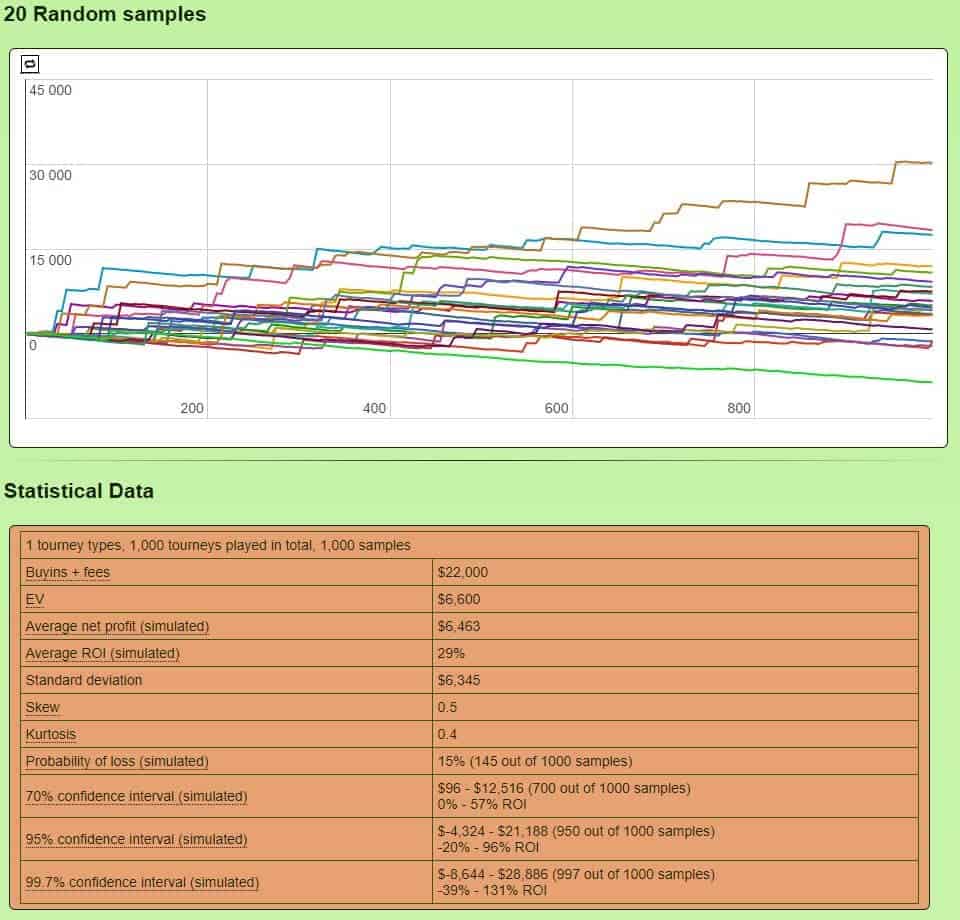
I ran a poker variance calculation so that you could see how it looks. Assuming you have a 30% ROI in the tournaments you play (which is an excellent result for anything but the lowest limits), you still have a 15% chance of losing money after playing 1000 tournaments.
So if your bankroll isn’t big enough to support the swings or you’ve been taking shots at higher stakes, it can be tough to continue playing your a-game and keeping the concentration.
While you may hate poker variance (which seems to be a very popular opinion), it is the only exact reason why poker remains profitable. It is precisely because of the variance that a weak, losing player can have massive winning sessions and walk away with a huge tournament hit. This illusion of luck keeps the poker economy alive.
Taking Poker Variance Head-On
Because poker variance is guaranteed to happen, you should be fully aware that there will be agonizing losing streaks in your career and proactively prepare for them. It means managing your bankroll in a way that mathematically ensures you never go bust, no matter how bad the cards fall. Eventually, things will even out, and you’ll regress back to your actual win rate.
However, the problem is that these rough periods severely affect your overall mental state, causing you to start second-guessing your strategies. The best way to deal with this problem is to take it head-on by:
- Analyzing your sessions with a completely open mind and proactively looking for strategy mistakes you might be making.
- Working heavily off the table with solvers and coaching tools to improve your strategy and analyze your opponents' tendencies.
- Looking for softer games or temporarily dropping down in stakes to comfortably get your confidence back.
Keeping Your Mental Game and Emotions in Check
With long-term poker variance, short-term bad beats, annoying opponents, and everything else you will encounter while playing, it can be extremely difficult to leave your emotions at the door. But as hard as it may be, mastering emotional detachment is the only way to succeed in poker.
The moment you let your emotions dictate any of your decisions at the table is the moment you need to stop and walk away.
Recognizing Signs of Tilt Triggered by Poker Variance
As Elliot Roe explains in his A-Game masterclass, every time you make a sub-optimal decision for whatever reason, it means you are tilting. You do not necessarily need to be screaming at the monitor, breaking your mouse, or aggressively spewing entire buy-ins to be officially recognized as tilting. Passive tilt and frustration are just as dangerous.

One of the most significant difficulties players face is recognizing when these subtle emotions start influencing their decisions. When you are in the heat of a long session and suffer a terrible beat or get aggressively bluffed out of a huge pot, your ego will instinctively tell you that you’re fine and that you are still playing your best game.
But your decisions might suddenly be far from optimal. You may struggle to notice that you are playing a wider range of hands or making marginal calls that you would never make in a normal, calm situation. Simply stopping for a few seconds and forcing yourself to think deeply about the next hand before you make any decision can help tremendously. Evaluate your planned play and give yourself a brutally honest answer to this question: Is this a play I would normally make, or am I just trying to win my money back?
If you recognize a decision is mathematically bad, but you still feel the urge to go through with it, that is a massive red flag. You need to stop playing immediately. Continuing in that compromised state of mind won’t bring anything good. You will enter “slot machine mode”, recklessly chasing after one big hand to recoup your losses.
Build a Habit To Quit Poker Session On Time
As we have already covered, if you are unable to play optimally because of your emotions or you become heavily distracted from the game, you should simply quit playing and take a break. In reality, that is the only legitimate reason you should ever shorten your planned grinding session.
However, a concept that many modern professionals profoundly disagree with is the idea of having a strict “stop-loss limit” based purely on your short-term monetary results.
The Flaws of Stop-Losses and Poker Variance
I am fully aware that a stop-loss (e.g., quitting after losing 3 buy-ins) is something that many old-school players still advise, but have you ever deeply thought about why? From a purely logical standpoint, it is hard to find a mathematically sound answer to this rule.
If you are perfectly capable of playing with full concentration and keeping your “A-game” intact, it shouldn't matter whether you are up or down a couple of buy-ins. In today's highly competitive games, win-rate edges are quite small, so naturally, you are going to encounter significantly larger swings. If you quit your session every single time you encounter a standard downswing, when are you actually going to put in the volume required to win?
If you blindly follow a stop-loss, you will miss out on highly profitable hours simply because you started a session with a standard bad beat. That will cost you a tremendous amount of Expected Value (EV) in the long run.
Of course, if you change your playstyle after losing those buy-ins and start making mistakes, like opening any two suited cards or chasing terrible draws just to get your money back, then you absolutely must quit. But you are quitting because you started playing poorly, not arbitrarily because you hit a financial loss limit.
The same exact logic applies to winning. Many players start playing overly tight, “scared poker” after winning a few buy-ins because they desperately want to lock up a winning day. You should never play a sub-optimal strategy just to protect a short-term profit. As the strategy experts at Upswing Poker regularly back up, if you can maintain your edge and play your absolute best, you should continue playing despite the swings. That is simply how the math of the game works.
Do Not Be Afraid of Resting and Recovery
Many poker players are highly competitive performers. They falsely believe that they should be grinding or studying every single waking minute of the day. However, this hustle culture inevitably leads to burnout, not optimal performance.
Working on your game is essential if you want to reach long-term success, but you should not easily skip resting as well.
Whenever you feel constantly tired, demotivated, or completely unprepared to play, do not force a session. Take a proper break or even just take a nap. Read a good book, exercise, spend time outdoors, or play a casual video game.
Do anything that helps you truly relax, as long as it is completely unrelated to gambling or poker. High-stress activities will only drain your dopamine further. After getting some high-quality rest, you will be able to return to the tables with renewed passion and sharp focus, which will easily pay for the time you spent away from the grind.
Conclusion: Strive to Play Your Best Game at All Times
There are countless elements to being a world-class poker player, and some of the most important ones don’t have much to do with cards, odds, or math. Poker is just as much about how you view the game mentally and how you physically prepare for it as it is about your strategic knowledge.
The only way to survive poker variance and succeed in the long run is if you can reconcile both sides of the spectrum. Keep working tirelessly on your strategy, but don’t forget to take care of yourself and continuously improve your overall life away from the tables. By achieving the right balance and knowing exactly where you are headed, you will give your poker career an incredible boost.
Key Takeaways for Mental Mastery:
- Understand your motivation: Know exactly why you play to ensure you keep your passion alive during the toughest downswings.
- Always prepare: Spend a few focused minutes preparing your mind and body before every single session to instantly improve your results.
- Embrace the math: Deeply understand how severe poker variance can be so you can prepare mentally and maintain a proper, bulletproof bankroll.
- Recognize tilt: Do not force yourself to play when you do not feel mentally sharp or when emotions start dictating your sizing.
- Value recovery: Find time to rest, disconnect completely, and clear your head between grinding sessions.
FAQ: Common Questions About Poker Variance