

A parlay in craps means adding all the winnings from a successful bet to the original stake and betting the full amount again. If a $10 bet wins $10, a full parlay makes the next bet $20. You collect none of that first win.
That is the meaning used in the craps glossary published by FunCity Resort. The size of the next wager depends on the payout: an even-money win doubles the stake, while a higher-paying bet can grow much faster.
A 10 dollar Pass Line parlay example
Suppose you put $10 on the Pass Line before a come-out roll. The shooter rolls 7, so you win $10. You now have $20: your original $10 plus the $10 win.
You put the full $20 on the Pass Line for the next come-out. Another 7 wins $20. If you stop and collect, you take away $40 in total, which is $30 more than the $10 you started with.
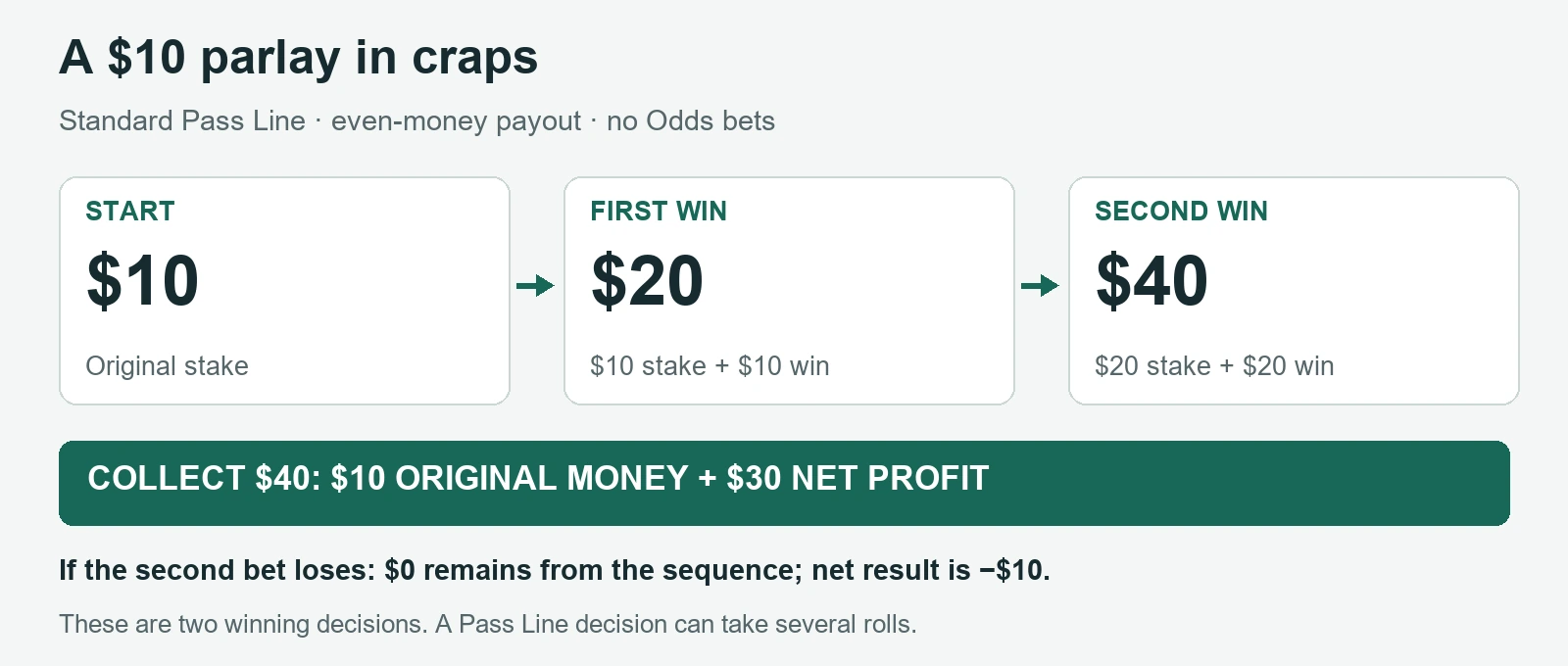
Two winning Pass Line decisions turn $10 into $40 total. The net profit is $30 if you collect everything.
The second payout is $20 in winnings, not $40 in profit. The other $20 is the stake being returned. If the second bet loses instead, all $20 on the layout is lost. Your net result for the two-bet sequence is then a $10 loss.
Parlay versus press in craps
Pressing means increasing a wager. You can use part of a win, all of it, or add chips from your rack. A full parlay is the specific choice of putting the original stake and the entire win back into action.
After the $10 even-money win above, you have $20 available. Keeping the next bet at $10 lets you collect $10. Raising it to $15 uses half the win and leaves $5 to collect. A full parlay puts all $20 on the next bet.
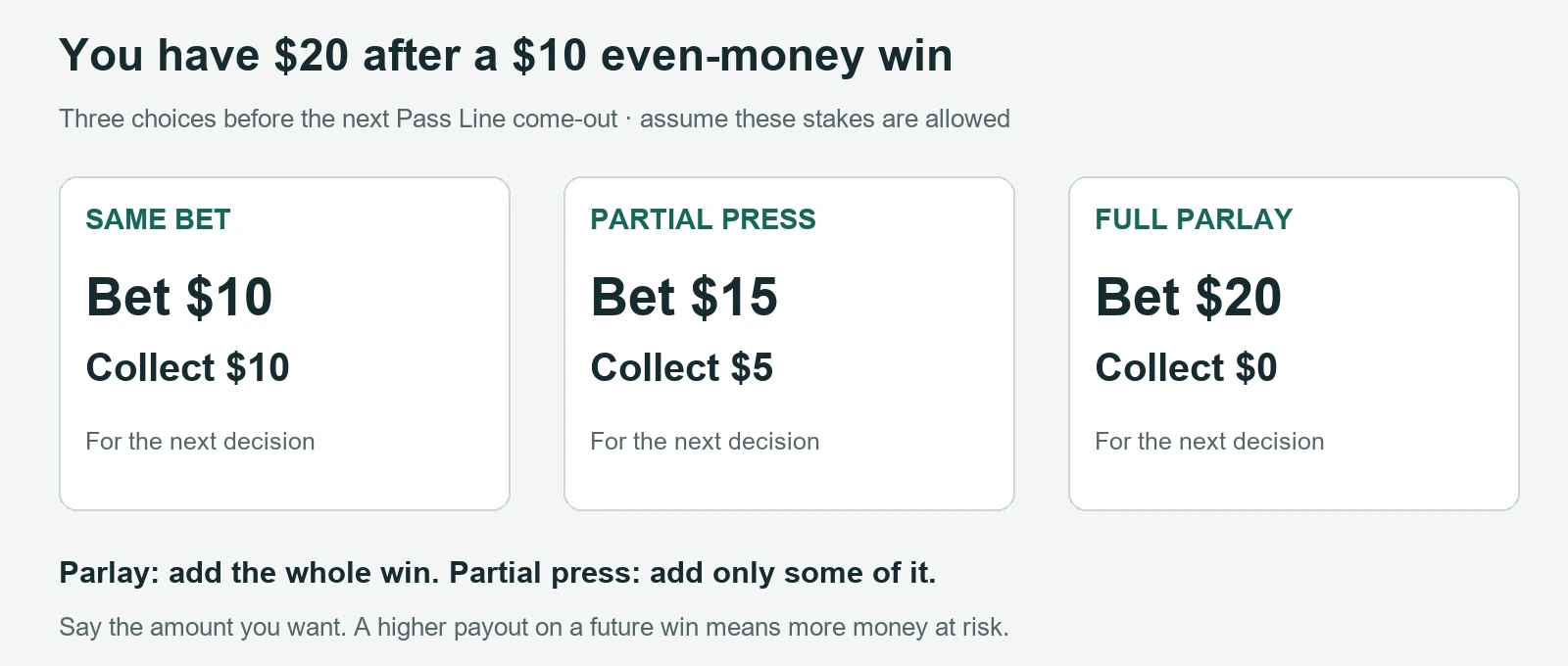
All three choices start with $20 available. The difference is how much you put at risk on the next bet.
Table calls are not perfectly uniform. “Press it” often means double the wager, and “let it ride” can be vague. Give the amount you want the dealer to leave up and the amount you want paid back. With Place bets, the usual betting units also matter; do not assume every possible total is a practical chip amount.
The next bet may take more than one roll
The two 7s in our example are come-out rolls. A Pass Line bet wins immediately on a come-out 7 or 11 and loses on 2, 3 or 12. Any other total establishes a point. The bet then waits for that point to repeat before 7; intervening rolls can leave it unresolved.
Our beginner’s guide to casino craps explains that sequence. You parlay after a win has been settled, rather than treating every throw as a new winning or losing Pass Line bet.
Can you parlay proposition bets?
Yes, if the table accepts the new amount. For example, a one-roll 11 bet paying 15 to 1 turns a $5 stake into $80 after a win: $75 in winnings plus the $5 stake. A full parlay would put all $80 on 11 for the next roll, subject to the table’s limits.
That larger bet still needs an 11. With fair dice, only two of the 36 equally likely combinations make 11. Winning the first bet does not improve the next roll’s one-in-18 chance. Any other total loses the full $80.
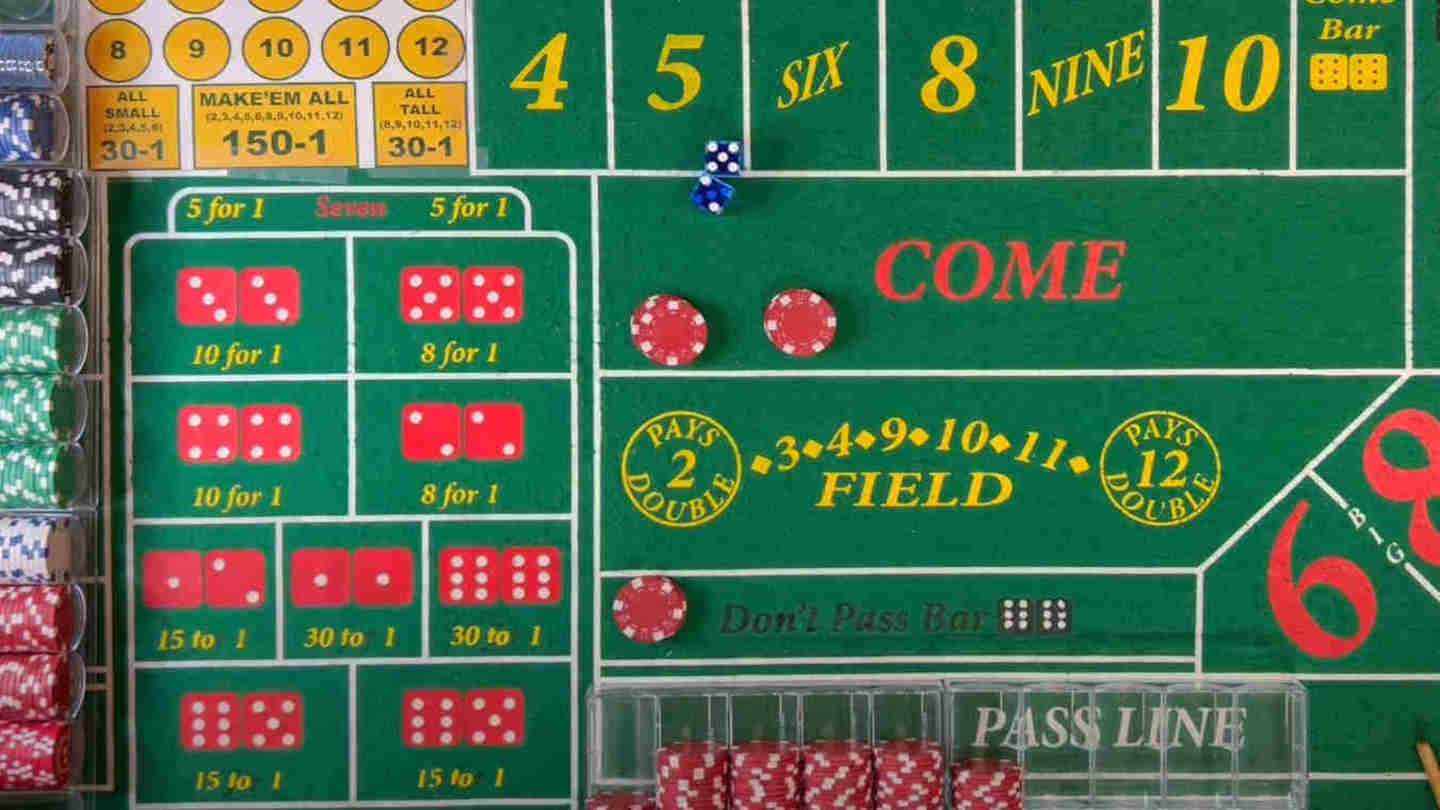
The Presque Isle Downs craps rules list this 15-to-1 payout. Check your own table’s paytable, and use our craps table layout guide to locate the different betting areas.
Does a parlay improve your odds
No. It increases the amount wagered and the potential payout, not the chance of the dice producing a winning result. Wizard of Odds’ craps analysis puts the standard Pass Line house edge at about 1.41% per resolved bet. Rebetting a win does not remove it.
The winnings are yours once the bet is paid. In the $10 example, only $10 came from your starting bankroll, but the second wager risks $20 you could have collected. Calling the extra $10 “house money” does not make it less real.
Common questions – FAQ