

ICM Poker is an essential concept for anyone looking to master multi-table tournaments (MTTs) and Sit & Gos (SNGs). While cash games are straightforward, with every chip having a fixed monetary value, tournaments introduce a completely different dynamic.
To stay ahead of the competition and make better decisions in the later stages of a tournament, you need to understand the Independent Chip Model (ICM).
What Does ICM Meaning in Poker?
The Independent Chip Model (ICM) is a mathematical model used to estimate a player's equity in a tournament based on their current stack size. Essentially, it is a method for converting tournament chips into real-money value.
ICM calculates this value using two main parameters:
- The payout structure: How the remaining prize pool is distributed.
- The stack sizes: The chip counts of all remaining players in the tournament.
As a mathematical model, standard ICM poker does not consider player skill, position, or table dynamics. Instead, it uses the available chip stacks and payout structure to estimate each player's share of the remaining prize pool. This is why ICM is commonly used as a starting point when players negotiate final-table deals and chops.
How Does ICM Poker Work?
To understand how ICM values chips, let's look at a simple $10 SNG example with three players. There is no rake, making the total prize pool $30. The winner gets $20, second place gets $10, and third place gets nothing.
At the start, all three players have 1,000 chips. Since everyone has the same stack, each player has an equal chance of finishing first or second, giving each stack an ICM value of exactly $10.
On the very first hand, the UTG player folds, and the Small Blind and Big Blind go all-in. The Big Blind is eliminated. Now, only two players remain:
- Player A (Chip Leader): 2,000 chips
- Player B: 1,000 chips
Both remaining players are guaranteed at least $10 for finishing second. Since Player A has twice as many chips as Player B, ICM estimates that Player A has a 66.7% chance of winning the remaining $10 for first place, while Player B has a 33.3% chance.
Converting the stacks to real-money value:
- Player A's 2,000 chips = $10 guaranteed + $6.67 equity for first place = $16.67
- Player B's 1,000 chips = $10 guaranteed + $3.33 equity for first place = $13.33
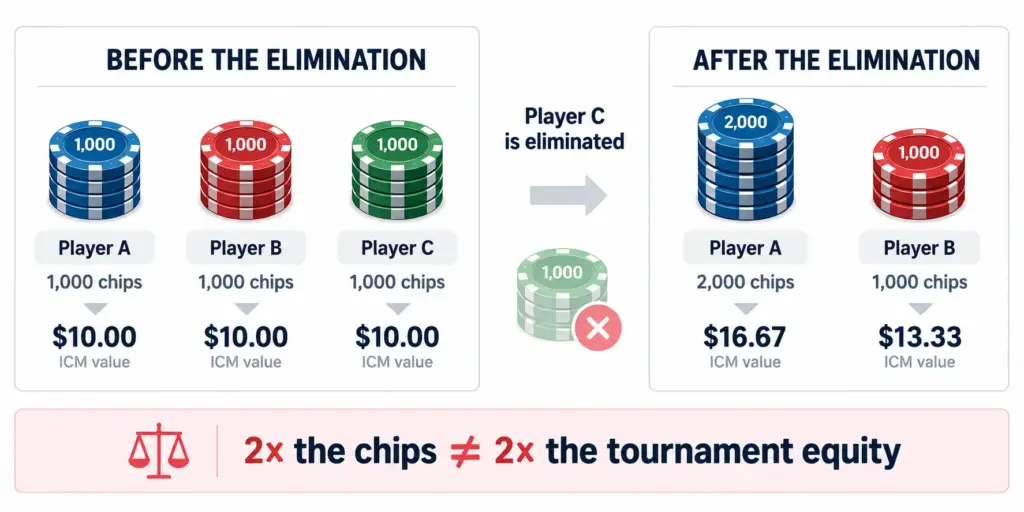
This simple example demonstrates one of the most important concepts behind ICM: tournament chips do not have a fixed monetary value.
Player A has twice as many chips as Player B, but their stack is worth only $3.34 more in tournament equity. The same principle becomes increasingly important as pay jumps and the risk of elimination become more significant.
ICM vs. Chip EV
One of the most common mistakes amateur players make is treating tournament chips like cash-game chips. To play winning tournament poker, you must understand the difference between Chip EV (cEV) and Tournament $EV.
- Chip EV (cEV): The expected value of a decision measured in tournament chips. A play is +cEV when it is expected to increase your chip stack over the long run.
- Tournament $EV: The expected value of a decision measured in real-money tournament equity.
In a cash game, cEV and monetary EV are effectively the same because every chip has a fixed cash value. In the early stages of a tournament, the difference between cEV and $EV is usually small because the payout structure has little immediate influence on individual decisions.
As the tournament progresses and players approach the money, pay jumps, or a final table, the two can diverge significantly. A shove or call can be profitable in terms of chips while still costing you tournament equity if the risk of elimination is too high.
The goal in a tournament is ultimately to maximize $EV, not simply to accumulate chips.
Why Are Tournament Chips Worth Different Amounts?
The fundamental idea behind ICM is that the chips you risk losing are generally worth more than the chips you stand to gain.
Look back at the SNG example. The player who lost the first all-in lost their entire 1,000-chip stack, which was worth $10. The player who won the all-in gained 1,000 chips, but their stack's real-money value only increased from $10 to $16.67.
They risked $10 in tournament equity to gain $6.67.
This happens because tournament payouts are distributed according to finishing position rather than the number of chips you accumulate. Moving up the payout ladder has real monetary value, while losing your entire stack eliminates your chance of collecting any further prize money.
That is why a tournament decision cannot always be judged by asking whether you have enough chip equity to justify the risk. You also need to consider what happens to your tournament equity if you lose.
What Is Risk Premium in Poker?
Because losing chips can hurt your tournament equity more than gaining the same number of chips can increase it, you often need more equity to justify calling an all-in. This additional equity requirement is known as Risk Premium.
The size of your risk premium depends on factors such as:
- The tournament payout structure
- Your stack size relative to the other players
- Your opponent's stack
- How close you are to a bubble or major pay jump
For example, a medium stack facing an all-in from a large chip leader may have a significant risk premium. Even if the hand appears profitable from a pure chip-EV perspective, calling and losing could eliminate the medium stack before several shorter stacks.
This is one reason why a hand that would be an easy call in a cash game can become a fold in a tournament.
What Is Bubble Factor?
Bubble Factor is a way of measuring the difference between the cost of losing chips and the benefit of winning them in a particular tournament situation.
A higher Bubble Factor means that losing an all-in is significantly more damaging to your tournament equity than winning the same amount of chips would increase it. As a result, you generally need a stronger hand to continue when Bubble Factor is high.
Bubble Factor can become particularly important when a medium stack faces a large stack near the money bubble. The medium stack has a lot of tournament equity to protect, while the big stack can often afford to take more risks and put pressure on opponents.
The exact Bubble Factor depends on the stack distribution and payout structure, so it can vary considerably from one tournament situation to another.
When Does ICM Poker Matter Most?
ICM technically applies throughout a tournament, but its practical impact is usually much smaller in the early stages. It becomes increasingly important as the value of surviving or moving up the payout structure increases.
Some of the most important situations include:
- Money Bubble: Busting one spot before the money can mean losing your entire remaining tournament equity, while surviving one more elimination guarantees a payout.
- Pay Jumps: As you move deeper in an MTT, some jumps between finishing positions can become extremely significant. This can create substantial ICM pressure.
- The Final Table: A large portion of the prize pool is often concentrated at the final table, making each elimination more financially significant.
- Satellites: Satellites have a unique structure because multiple players may receive the same prize, such as a tournament ticket. Once a player has enough chips to secure a seat, preserving those chips can become far more important than accumulating more.
In extreme satellite situations, folding even very strong hands can sometimes be mathematically correct if winning additional chips provides little or no additional payout equity.
ICM Poker Examples
To see how ICM affects real decisions, let's look at three common tournament situations.
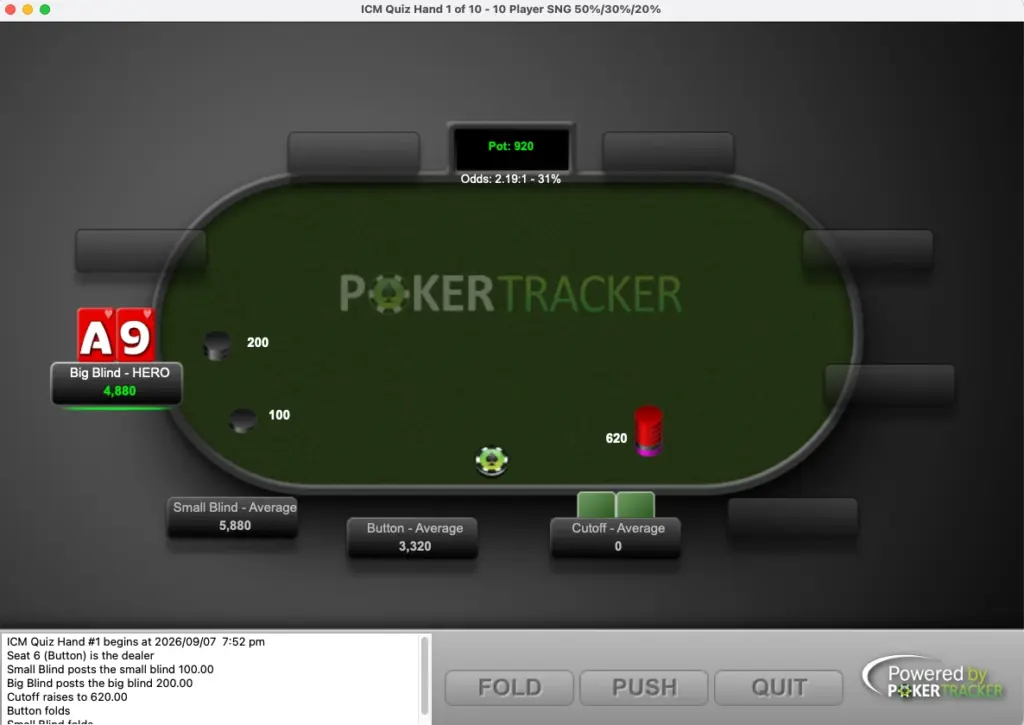
Example 1 – Folding AK on the Bubble
You are playing a 9-handed SNG where three players get paid. Four players remain, and you have a comfortable stack in the Big Blind. The Button, who is the chip leader, moves all-in. You look down at A-K suited.
From a pure Chip EV perspective, calling against a wide button shoving range can be very profitable.
However, suppose the Small Blind has just 1 BB. If you call and lose, you finish fourth and receive nothing. If you fold, the short stack may be eliminated on the next few hands, guaranteeing you a cash.
In this situation, the value of preserving your stack can outweigh the chip EV of calling with a strong hand. Your risk premium is therefore high, and folding AK can be correct despite the hand having substantial equity against the opponent's range.
Example 2 – Big Stack vs. Medium Stack
There are 15 players left in an MTT. You are the chip leader with 80 BBs. The player to your left has 40 BBs, while most of the other players at the table have between 10 and 20 BBs.
The 40 BB stack has a strong incentive to avoid unnecessary confrontations with you because several shorter stacks are at risk of elimination.
This allows you to apply pressure. You can open more aggressively, particularly when the medium stack is likely to have to fold hands that would otherwise be playable.
The important point is not simply that the medium stack should fold everything. Rather, ICM changes the cost of taking marginal risks, allowing the chip leader to put pressure on opponents whose tournament equity is more vulnerable.
Example 3 – Medium Stack vs. Short Stack
Now imagine you are the 40 BB medium stack from the previous example.
Your strategy changes depending on which opponent you are facing. You generally want to avoid taking marginal risks against the chip leader, while you can often put pressure on shorter stacks who are also trying to protect their tournament equity.
However, that does not mean short stacks automatically have low risk premiums or should call extremely wide. Their optimal strategy still depends on the payout structure, stack distribution, and proximity to the bubble.
The key lesson is that ICM pressure is relative. The same hand can have a very different value depending on which stack you are playing against and what the other stacks at the table look like.
How to Use ICM Poker in MTTs and SNGs
You cannot calculate complex ICM situations accurately in your head while playing. Instead, the best way to use ICM is to study these spots away from the table and develop an intuition for how different stack distributions affect your decisions. For online poker players, ICM calculators and training tools make it much easier to practice these situations regularly.
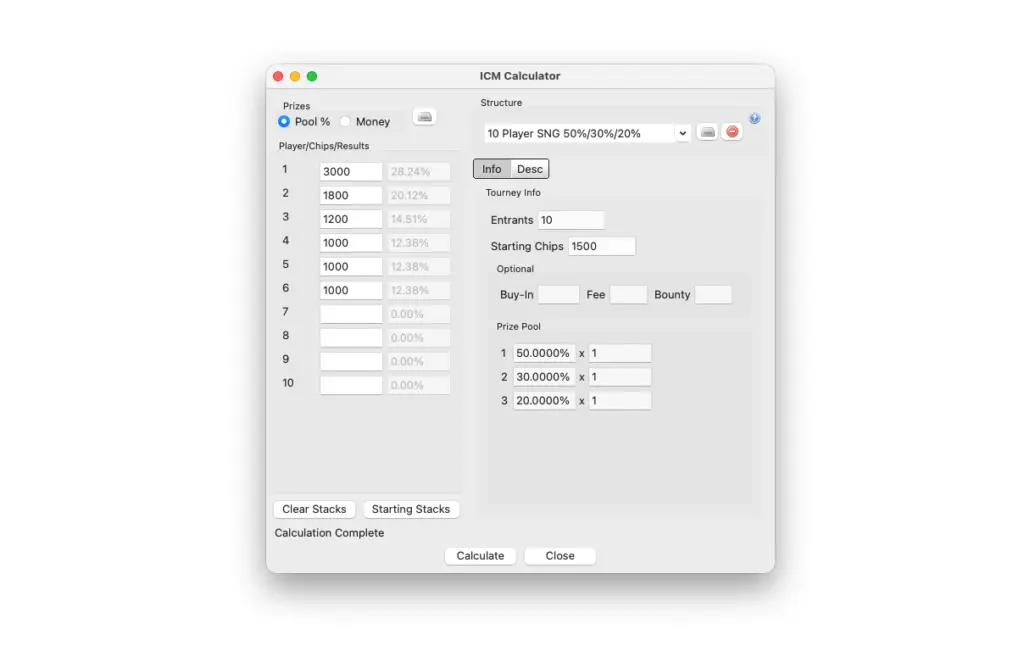
An ICM calculator can help you understand:
- Which hands you should call or fold on the bubble
- How wide you can shove as a big stack
- How much tighter you should play as a medium stack
- How payout jumps affect your calling ranges
- Which marginal chip-EV spots become negative in tournament $EV
Reviewing your own MTT hands with an ICM tool is particularly useful after deep runs, where a few decisions can have a significant impact on your expected payout.
The Limitations of ICM Poker
ICM poker is a powerful mathematical model, but it is not a perfect representation of every tournament situation. It provides a strong baseline for understanding the value of your stack, but several factors can influence your decisions beyond what the model can calculate.
Here are the main limitations of ICM:
- Skill Edge: ICM assumes all players have the same ability to turn chips into future tournament equity. In reality, a strong player may be able to generate more value from a stack than a weaker opponent, which can sometimes justify taking a marginal risk.
- Table Dynamics: ICM does not know what is happening at the table. If two big stacks are avoiding each other, for example, you may be able to apply more pressure to the other players. Likewise, aggressive players or likely confrontations can change the value of taking a marginal spot.
- Future Decisions: Standard ICM evaluates the current tournament situation rather than fully modeling future hands. A decision that looks slightly unfavorable now can sometimes be attractive if winning the pot gives you a dominant stack for the rest of the tournament.
- Opponent Tendencies: ICM calculations depend on the ranges and decisions you assign to your opponents. If a player is calling much wider than expected, you should adjust your strategy rather than blindly following an ICM recommendation.
This does not mean you should ignore ICM whenever you have a read on your opponents. Instead, treat it as a mathematical baseline that helps you understand the cost of taking risks.
The goal is not to follow ICM blindly, but to understand why the model recommends a particular decision and when the conditions at the table give you a reason to deviate from it.
Does ICM Poker Work in PKO Tournaments?
Standard ICM alone is not enough to accurately evaluate decisions in Progressive Knockout (PKO) and other bounty tournaments. In these formats, part of the prize pool is attached to the players as bounties, creating an additional source of tournament equity.
Your decisions therefore need to account for both:
- Tournament $EV: The value of surviving and moving up the regular payout structure.
- Bounty EV: The immediate value you can gain by eliminating another player.
This can significantly change the decisions you make compared with a regular MTT. A call that would be too loose under standard ICM can become profitable when the potential bounty is large enough to compensate for the additional risk.
The same applies when deciding whether to risk your own tournament life. A large bounty on another player can sometimes make calling with a wider range correct, even when the situation would normally carry significant ICM pressure.
However, this does not mean you should simply ignore ICM in PKOs. The value of the bounty depends on factors such as the size of the bounty, the remaining payouts, your stack size, and your opponent's stack. The later stages of a PKO can therefore require a careful balance between protecting your tournament equity and pursuing valuable bounties.
For accurate PKO analysis, you should use tools that account for both ICM and bounty values rather than relying on a standard ICM calculator alone.
Best Tools for Studying ICM
The best way to improve your understanding of ICM is to study real tournament hands and compare your decisions with an ICM-based solution. While you cannot calculate complex ICM spots accurately at the table, dedicated poker training software can help you understand how stack sizes and payout structures affect your decisions.
PokerTracker 4‘s ICM Quiz lets you practice tournament decisions and see how your choices compare with an ICM-based solution.
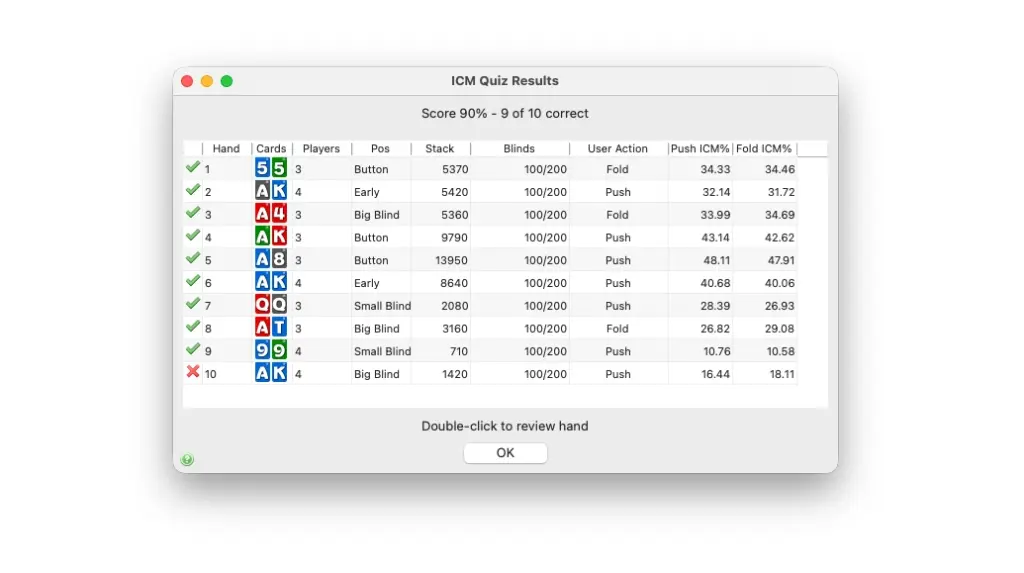
When studying ICM, look for tools that allow you to:
- Enter the stack sizes and tournament payouts
- Analyze specific push, call, and fold decisions
- Compare different ranges and scenarios
- Study Risk Premium and Bubble Factor
- Use Future Game Simulation (FGS) for more advanced situations
ICM calculators are particularly useful for reviewing hands from the later stages of MTTs and SNGs. Instead of simply checking whether a decision was correct, try changing the stack sizes, payouts, or opponents' ranges to see how the recommended strategy changes.
For more advanced study, some poker tools also support FGS and PKO calculations. These features can give you a more complete picture of tournament decisions than a basic ICM calculation alone.
The most important thing is not to memorize individual ranges, but to understand why the ranges change as the tournament situation changes. Regularly reviewing your own deep runs and difficult bubble spots is one of the best ways to build practical ICM intuition.
ICM Strategy: Key Takeaways
- ICM changes the value of tournament chips: Chips do not have a fixed monetary value, and losing chips can cost more tournament equity than gaining the same number of chips provides.
- Think in $EV, not just Chip EV: A play can be profitable in chips but still lose tournament equity when ICM pressure is high.
- Understand Risk Premium: The closer you get to important bubbles and pay jumps, the more equity you may need to justify calling an all-in.
- Use your stack strategically: Big stacks can often apply pressure to medium stacks, while medium stacks need to be more selective about taking risks against players who cover them.
- ICM is not the whole story: Skill edge, table dynamics, opponent tendencies, and future game situations can all influence the best decision.
- Adjust for PKOs: Standard ICM does not account for bounty value, so PKO decisions require both tournament $EV and Bounty EV to be considered.
- Study, don't memorize: Use ICM calculators and FGS tools to review difficult spots and understand why your ranges change as the tournament situation changes.
The most important takeaway is simple: ICM is a framework for making better tournament decisions, not a strategy you should follow blindly. Once you understand how stack sizes, payouts, and risk interact, you can use ICM as a baseline and make better adjustments at the table.
Frequently Asked Questions (FAQ)