


Ultimate Texas Hold’em is one of the most popular casino table games because it combines familiar poker hand rankings with simplified decision-making. Unlike traditional Texas Hold’em, you are not playing against other players – you are playing against the dealer.
Because of this structure, counting outs in Ultimate Texas Hold'em works differently than in regular poker. Instead of calculating your chances to improve your hand, you are calculating how many unseen cards allow the dealer to beat you.
Understanding this concept is essential for minimizing the house edge and forming a solid Ultimate Texas Hold’em strategy, especially when facing river decisions.
What is an Out in Ultimate Texas Hold’em?
In traditional poker, an out is usually a card that improves your hand.
In Ultimate Texas Hold’em, when facing a river decision, an out is:
Any unseen card that allows the dealer to make a stronger five-card hand
than yours.
Since the dealer receives two hole cards from the remaining deck, you must consider how many of those remaining cards will result in a losing outcome for you.
This is a crucial distinction. You are not calculating draw odds – you are calculating danger cards.
A Practical Example of Counting Outs
Let’s look at a clear river situation.
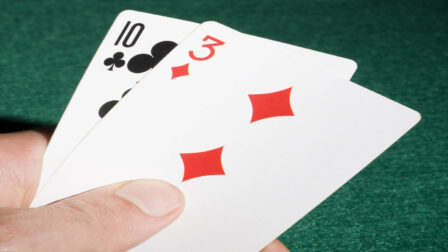
You hold:
10♠ 3♦
The board shows:
A♣ Q♥ 8♦ 6♠ 4♣
Your best five-card hand is:
A-Q-10-8-6
Now we determine how many dealer holdings beat this hand.
Any Board Pair (15 Outs)
There are five different ranks on the board (A, Q, 8, 6, 4).
Each of these ranks has three remaining unseen cards in the deck.
5 ranks × 3 cards each = 15 outs
If the dealer holds any of these cards, they make at least one pair and beat
Your Ten-high hand.
Higher Overcards (8 Outs)
If the dealer holds:
- Any King
- Any Jack
They make a higher high-card hand than yours.
There are 4 Kings and 4 Jacks remaining in the deck.
= 8 additional outs
Ten combinations (Partial Outs)
Three Tens remain in the deck.
However, not every Ten automatically beats you.
If the dealer holds:
- Ten + very low card (for example, 2 or 3)
- The final five-card hand will still be A-Q-10-8-6, resulting in a push.
The dealer only wins with a Ten if their second card improves their kicker structure – for example, a 9 or 7 – allowing them to form a better five-card combination such as:
A-Q-10-9-8
Because of this, Tens are not clean automatic outs. Some Ten combinations result in a push, while others produce a win for the dealer.
For simplified strategic estimation in borderline river spots, many players treat these marginal cases conservatively, but strictly speaking, they are combination-dependent rather than guaranteed losing outs.
Applying the Outs Threshold
In this example, the clearly losing outs come from:
- 15 board-pair cards
8 higher overcards
That already totals 23 strong outs, before considering any Ten-based improvements.
With 45 unseen cards remaining, this means more than half of the deck (23 out of 45 cards, or roughly 51%) produces a losing outcome.
This comfortably exceeds the commonly used decision threshold in Ultimate Texas Hold’em.
The 21-Out Guideline in Ultimate Texas Hold’em
Through mathematical simulations of river decisions, a practical rule of
thumb has emerged:
If the dealer has 21 or more clean outs, folding is typically correct.
If the dealer has 20 or fewer outs, calling is generally optimal.
This guideline exists because Ultimate Texas Hold’em is a mathematically structured game. Your goal is not to outplay an opponent psychologically – it is to minimize negative expectation.
In this example, even without counting every possible Ten combination, the dealer already exceeds the 21-out threshold. The correct strategic decision is to fold.
Why Counting Outs Matters in UTH
Unlike traditional poker, you cannot:
- Bluff the dealer
- Apply pressure
- Change their strategy
Every decision is purely mathematical.
Incorrect river calls in high-out situations significantly increase long-term losses. By counting outs carefully and applying the threshold rule, you ensure that you are playing close to an optimal strategy and minimizing the house edge.
Over time, common board textures become easier to evaluate quickly. You will begin recognizing high-danger structures without recalculating every single card.
Common Mistakes When Counting Outs
Confusing UTH with regular Texas Hold'em
Draw odds, implied odds, and pot pressure do not apply here. You are evaluating dealer improvement, not your own drawing equity.
Treating all ranks as automatic outs
As seen in the Ten example above, some cards are conditional rather than guaranteed losing outs. Always consider five-card hand construction.
Ignoring kickers
Even in high-card situations, the fifth card matters. Small differences in kicker composition can change a loss into a push.
If you’d like to put this strategy into practice, many reputable online poker rooms also offer casino table games like Ultimate Texas Hold’em. Playing on a trusted platform allows you to apply structured decision-making in real conditions while keeping your bankroll organized in one place.
FAQ About Counting Outs in Ultimate Texas Hold'em
Final Thoughts
Counting outs in Ultimate Texas Hold'em is one of the most powerful tools you can use at the table. It transforms vague intuition into structured, math-based decision-making.
By identifying clean losing outs, understanding conditional combinations, and applying the 21-out guideline, you dramatically reduce costly river mistakes and keep the house edge as low as possible.
Ultimate Texas Hold’em rewards discipline. Mastering outs calculation ensures that every decision you make is grounded in probability – not guesswork.